Table of Contents
ToggleThe Timurids: Rise of the Timurid Empire, Timur’s Invasion of India
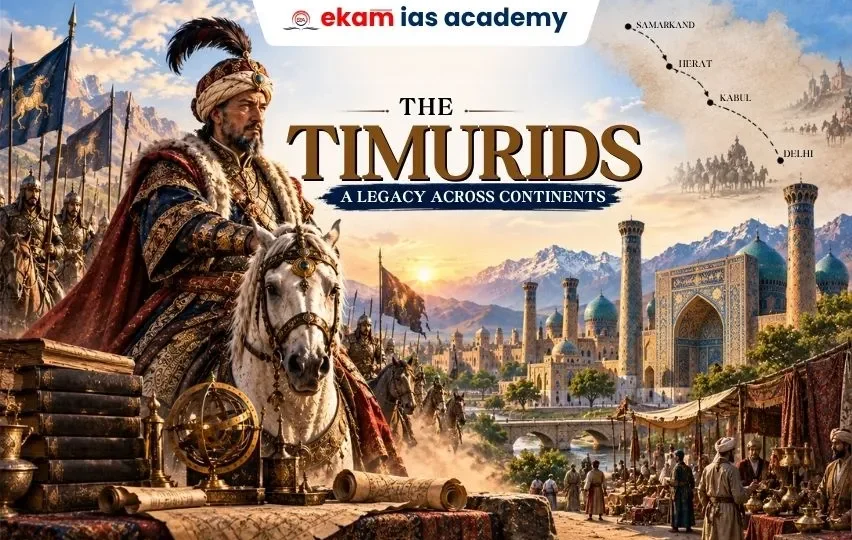
The history of The Timurids represents a pivotal epoch that bridged Central Asian geopolitical dynamics with the Indian subcontinent. Established in the late 14th century, the Timurid Dynasty served as a major political, military, and cultural catalyst across Eurasia. Understanding Timurids UPSC core themes unveils how Central Asian administrative models and intellectual movements paved the way for the Mughal era in Medieval Indian History UPSC.
Origin of the Timurid Dynasty
- Founded by Amir Timur (Tamerlane), a Turco-Mongol conqueror claiming political descent from Genghis Khan.
- Emerged in Transoxiana during the mid-14th century following the division and decay of the Chagatai Khanate.
- Synthesized nomadic Mongol military strategies with settled Islamic Persianate political tradition.
Amir Timur and His Major Conquests
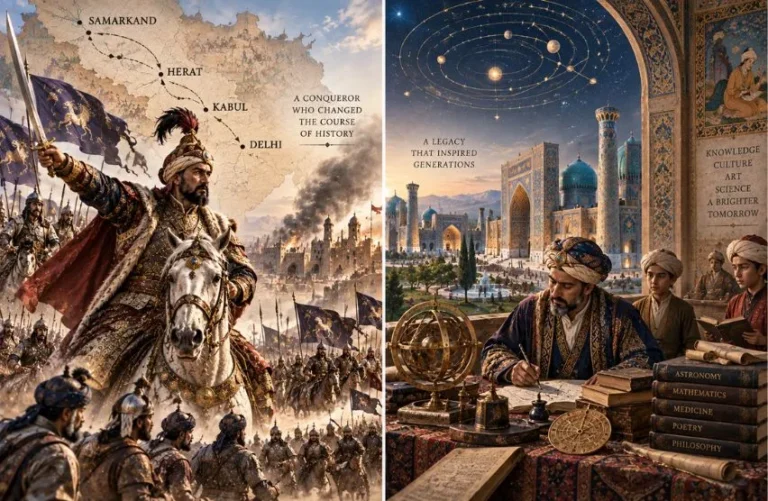
- Spearheaded military campaigns spanning Persia, Mesopotamia, Anatolia, the Golden Horde, and Central Asia.
- Orchestrated Timur’s Invasion of India in 1398, pillaging Delhi and leaving the Delhi Sultanate severely fragmented.
- Consolidated Samarkand as a grand global capital through vast wealth and imported artisans.
Political and Administrative Structure of the Timurid Empire
- Governed through a appanage system where princes (Mirzas) administered imperial provinces.
- Blended Islamic Sharia law with Mongol Yassa legal customs within imperial administration.
- Depended on a elite military aristocracy of Turco-Mongol chieftains to preserve regional stability.
Major Timurid Rulers
- Shah Rukh (r. 1405–1447) shifted the imperial capital to Herat and presided over a golden age of diplomacy and arts.
- Ulugh Beg ruled Samarkand as a scholar-king dedicated to scientific inquiry and regional trade.
- Sultan Husayn Bayqara governed Herat, turning it into the cultural peak of the late Timurid era.
Timurid Culture, Art, and Architecture
- Sparks of the Timurid Renaissance featured brilliant Persian literature, miniature painting, and calligraphy.
- Timurid Architecture introduced monumental domes, turquoise tilework, and double-dome engineering.
- Shaped Timurid Culture through courtly patronage of poets like Jami and painters like Bihzad.
Ulugh Beg and Scientific Development
- Ulugh Beg established the renowned Samarkand Observatory in 1420 to advance astronomical studies.
- Compiled the Zij-i Sultani, one of the most accurate stellar catalogs of the medieval world.
- Transformed Samarkand into a premier international institution for mathematics and astronomy.
Timurid Relations with India
- Timur’s Invasion of India crippled the Tughlaq dynasty and hastened the breakup of northern India.
- Appointed Khizr Khan as governor of Multan, which led directly to the founding of the Sayyid Dynasty.
- Established permanent trade, diplomatic, and artistic exchanges between Central Asia and Punjab.
Decline of the Timurid Empire
- Destabilized by succession wars caused by the lack of a fixed rule of primogeniture.
- Divided into rival principalities centered around Samarkand, Herat, and Fergana.
- Weakened by internal economic drain and continuous feuds among rival Timurid princes.
Rise of the Uzbeks and the End of Timurid Rule
- Nomadic Uzbek tribes under Muhammad Shaybani Khan pushed south into Transoxiana.
- Shaybani Khan captured Samarkand and Herat in the early 16th century, ending Central Asian Timurid rule.
- Forced surviving Timurid rulers to seek new bases outside Transoxiana.
The Timurids and the Foundation of the Mughal Empire
- Direct lineage links Timur and Babur, as Babur was a fifth-generation grandson of Timur.
- Driven out of Fergana, Babur established himself at Kabul before turning toward northern India.
- The Mughal Empire represented the continuation of Timurid political ideals and architectural styles in South Asia.
Important Dates in Timurid History
- 1370: Amir Timur establishes the Timurid Empire with Samarkand as its capital.
- 1398: Timur’s Invasion of India sacks Delhi and weakens the Sultanate.
- 1420: Ulugh Beg builds the famous Samarkand Observatory.
- 1507: Uzbek conquest of Herat marks the end of main Timurid rule in Central Asia.
Important Facts for UPSC Prelims
- Timurid Empire UPSC core note: The Mughals preferred calling themselves Timurids (Gurkani).
- Bihzad, the “Raphael of the East,” developed his famed miniature painting style under late Timurid patronage.
- Timurid Architecture features (double domes and grand iWans) directly inspired Mughal structures like Humayun’s Tomb and the Taj Mahal.
Conclusion
The legacy of The Timurids remains central to understanding the transition from the Delhi Sultanate to the Mughal period. While the Timurid Dynasty collapsed in Central Asia under Uzbek pressure, its cultural, architectural, and political traditions flourished in India through Babur, leaving an enduring mark on South Asian history.
UPSC Prelims: PYQs & Practice Questions
Previous Year Questions (Prelims)
Q: Which of the following dynasties was ruling over Delhi at the time of Timur’s invasion of India (1398 AD)?
(a) Slave Dynasty
(b) Khilji Dynasty
(c) Tughlaq Dynasty
(d) Sayyid Dynasty
Answer: (c) Tughlaq Dynasty
Explanation:
Timur invaded India in 1398 AD during the reign of
Sultan Nasiruddin Mahmud Shah Tughlaq, the last ruler of the
Tughlaq dynasty.
The invasion dealt a fatal blow to the Tughlaq dynasty, causing the central authority of Delhi to collapse and paving the way for the rise of the Sayyid Dynasty under Khizr Khan.
Q: Consider the following statements regarding the Timurid ruler Ulugh Beg:
1. He is known for establishing a major astronomical observatory at
Samarkand.
2. He authored the Zij-i Sultani, a comprehensive
stellar catalog of the medieval world.
Which of the statements given above is/are correct? (UPSC CSE Prelims 2012)
(a) 1 only
(b) 2 only
(c) Both 1 and 2
(d) Neither 1 nor 2
Answer: (c) Both 1 and 2
Explanation:
Statement 1 is correct: Ulugh Beg, a prominent Timurid ruler and
grandson of Timur, constructed the famous
Samarkand Observatory in 1420 to advance scientific and astronomical research.
Statement 2 is correct: He authored the Zij-i Sultani, one of the most accurate astronomical and trigonometric star catalogues compiled in medieval times.
Practice Questions
Q: With reference to the architectural influence of the Timurid Dynasty on the Mughal Empire, consider the following statements:
1. The double-dome structure and grand iwan
(vaulted portal) were key features borrowed by Mughal architects from Timurid design.
2. Humayun’s Tomb in Delhi represents one of the earliest examples of
Timurid architectural synthesis in India.
Which of the statements given above is/are correct?
(a) 1 only
(b) 2 only
(c) Both 1 and 2
(d) Neither 1 nor 2
Answer: (c) Both 1 and 2
Explanation:
Statement 1 is correct: Timurid architecture introduced
high bulbous double domes, ceramic tilework, and grand symmetrical entrance arches
(iwans), which heavily influenced Mughal construction.
Statement 2 is correct: Designed by the Persian architect Mirak Mirza Ghiyas, Humayun’s Tomb reflects a strong fusion of Timurid structural principles and local Indian craftsmanship.
Q: Who among the following was appointed as the Governor of Multan and Lahore by Timur, subsequently establishing the Sayyid Dynasty in Delhi?
(a) Bahlul Lodi
(b) Khizr Khan
(c) Mubarak Shah
(d) Shams-ud-Din Iltutmish
Answer: (b) Khizr Khan
Explanation:
Before departing from India in 1399, Timur appointed his viceroy
Khizr Khan as governor of Multan, Lahore, and Dipalpur.
Khizr Khan captured Delhi in 1414 AD and founded the Sayyid Dynasty, ruling as a vassal of the Timurid empire.
UPSC Mains – Previous Year & Practice Questions
Mains Previous Year Questions
Question: "Timur’s invasion of 1398 AD was not a temporary military raid, but a decisive geopolitical rupture that shattered the administrative spine of the Delhi Sultanate." Analyze. (UPSC CSE Mains 2016)
Question: Discuss the role played by the Timurid Renaissance in shaping the literary, scientific, and artistic traditions of Central Asia and South Asia. (UPSC CSE Mains 2011)
Question: Analyze the legacy of the Timurid political system on the administrative and territorial framework of the early Mughal state under Babur and Humayun. (UPSC CSE Mains 2004)
Question: Compare the socio-political impact of the Mongol invasions with that of Timur's invasion on the Delhi Sultanate. (UPSC CSE Mains 1996)
Question: Evaluate the contribution of Ulugh Beg to medieval science and astronomy during the golden age of the Timurid Dynasty. (UPSC CSE Mains 1989)
Mains Practice Questions
[15 Marks | 250 Words]
Question: The Timurid appanage system of territorial administration fostered internal political fragmentation while simultaneously driving cultural expansion. Discuss.
[15 Marks | 250 Words]
Question: Trace the stylistic evolution from Timurid architectural monuments in Samarkand and Herat to classical Mughal monuments in India.
[15 Marks | 250 Words]
Question: How did the geopolitical conflict between the Uzbeks, Safavids, and Timurids in Central Asia facilitate the displacement of Babur and the eventual birth of the Mughal Empire in India?
The Timurids: Rise of the Timurid Empire, Timur’s Invasion of India-FAQs
Who were the Timurids?
The Timurids were a Turco-Mongol dynasty founded by Amir Timur in Central Asia, with Samarkand and Herat emerging as major political and cultural centres.
Why are the Timurids important for Indian history?
The Timurids are important because Timur’s invasion weakened the Delhi Sultanate, while Babur later carried Timurid political traditions into India through the Mughal Empire.
Who was Ulugh Beg?
Ulugh Beg was a Timurid ruler, astronomer and scholar who developed Samarkand as a major centre of mathematics and astronomy.
How did the Timurid Empire decline?
The Timurid Empire declined due to succession wars, fragmented principalities, weak central control and the rise of Uzbek power under Muhammad Shaybani Khan.
Why are The Timurids important for UPSC?
They are important for UPSC because they connect Central Asian politics, Timur’s invasion, Babur, Mughal foundations, Persianate culture, architecture and medieval Indian history.