

The debate on Jammu & Kashmir’s economic future has renewed attention on its strategic location between South Asia, Central Asia and the wider Eurasian region.
J&K’s Demographic and Economic Potential
- J&K has a young population and a growing pool of educated and technically trained youth.
- The J&K Economic Survey 2025–26 notes that about 69% of the population is below 35 years.
- Its economy has strong potential in: Tourism and hospitality, Hydropower, Logistics and border-area commerce
- The services sector contributes the largest share of J&K’s GSVA, while agriculture continues to support a large workforce.

From Historical Crossroads to Modern Connectivity
- Historically, Kashmir was connected with Central Asia, Ladakh, Tibet and the Indian subcontinent through caravan and cultural routes.
- Such routes enabled movement of goods, crafts, people, ideas and knowledge.
- This historical experience shows how connectivity can create wider economic ecosystems rather than merely transport links.
Eurasian Connectivity
- India already uses alternative routes to strengthen access to Central Asian markets.
- International North-South Transport Corridor (INSTC) connects India with Iran, Central Asia, Russia and Europe through a multimodal network.
- Chabahar Port provides India an important route towards Afghanistan and Central Asia, reducing dependence on a single land route.
- At the 4th India-Central Asia Dialogue in 2025, countries emphasised greater use of INSTC and Chabahar and supported stronger trade, investment and financial connectivity.
Potential Benefits for J&K
- Employment: Construction, logistics, tourism, warehousing and services can create jobs.
- MSME growth: Better connectivity can expand markets for Kashmiri handicrafts, horticulture and processed products.
- Tourism: Improved regional connectivity could support cultural, adventure and heritage tourism.
- Investment: Infrastructure can attract private investment into logistics, hospitality and manufacturing.
- Youth entrepreneurship: J&K’s Mission YUVA seeks to create enterprises and employment through finance, skills and market connectivity.
Challenges
- Security concerns: Cross-border terrorism and sensitive borders constrain movement and infrastructure development.
- Geography: Mountainous terrain increases the cost and complexity of roads, railways and logistics.
- Diplomatic constraints: Regional connectivity involving Pakistan, China and Central Asia requires sustained diplomatic engagement.
- Infrastructure gaps: Storage, multimodal logistics, digital connectivity and border infrastructure need further development.
Way Forward
- Develop connectivity phased and security-sensitive, beginning with economically feasible corridors.
- Strengthen Chabahar and INSTC while improving customs, logistics and multimodal transport.
- Ensure Himalayan infrastructure follows environmental carrying-capacity and disaster-resilience principles.
- Use regional diplomacy to promote connectivity while protecting sovereignty and territorial integrity, consistent with India’s stated connectivity approach.
Conclusion:
Jammu & Kashmir can contribute to India’s Eurasian ambitions when connectivity, youth opportunity, economic integration and security are pursued as complementary objectives.
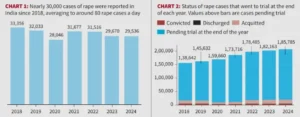
A recent analysis of NCRB data highlights that rape cases have remained broadly stable, but court pendency has steadily increased.
Crime and Justice
- Rape cases registered remained around 30,000 annually. This averages roughly 80 cases a day during the period.
- However, the trial backlog has continuously expanded, indicating that the justice system is unable to dispose of cases at the pace at which they enter the courts.
- In 2024, around 2.07 lakh rape cases were in the trial pipeline; nearly 90% remained pending at year-end.
- Of 20,587 cases disposed of by courts, about 68% ended in acquittal, 8% in discharge and 24% in conviction.
- Only 421 cases resulted in conviction within the same year, about 2% of cases taken up for trial. This should not be confused with the overall conviction rate, which is below 30%.
Where the Delay Occurs
- Investigation stage: Around 40,000 cases were taken up for investigation in 2024; nearly 25,000 were chargesheeted.
- Court stage: New chargesheets add to the large existing trial backlog.
- Delays can arise from inadequate investigators, forensic capacity, witnesses, repeated adjournments and complex evidence.
- NCRB data therefore shows a justice-chain problem, not merely a shortage of laws.
Legal and Institutional Framework
- BNSS Section 193: investigation in specified rape and sexual-offence cases must be completed within two months.
- BNSS Section 346: trial for specified sexual offences is required to be completed within two months of filing the chargesheet, with day-to-day proceedings subject to permitted exceptions.
- Fast Track Special Courts (FTSCs): created for quicker disposal of rape and POCSO cases; 779 FTSCs, including exclusive POCSO courts, are currently functional.
- MHA supports DNA, cyber-forensic capacity and training of police and prosecutors dealing with sexual offences.
Way Forward
- Strengthen investigative manpower, forensic laboratories and evidence-collection protocols.
- Use district-wise dashboards to monitor investigation and trial timelines.
- Improve survivor support through legal aid, counselling, compensation and witness protection.
- Combine punitive measures with safer public spaces, gender sensitisation, prevention and community awareness.
Conclusion:
Effective justice requires not only stringent laws, but a fast, evidence-based and survivor-sensitive justice chain from FIR to final judgment.
FIBRE-OPTIC CABLES
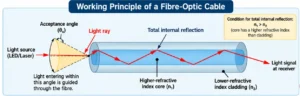
- Fibre-optic cables are communication cables made of very thin strands of glass or plastic that carry digital information.
- They transmit data as pulses of light, enabling very high-speed communication over long distances.
- Light travels through the fibre by Total Internal Reflection (TIR), keeping the signal within the fibre.
- They offer high bandwidth, low signal loss and fast data transmission, making them essential for the Internet, telecommunications and subsea connectivity.
India’s growing nuclear programme has increased the need for safe, long-term radioactive waste management, especially under its closed fuel-cycle approach.
India’s Closed Fuel Cycle
- Unlike a once-through system, India treats spent nuclear fuel as a resource because uranium and plutonium can be recovered through reprocessing.
- This approach aims to improve fuel utilisation and support India’s long-term thorium-based energy strategy.
- However, reprocessing does not eliminate radioactivity; high-level residues still require safe isolation.
How is Nuclear Waste Managed?
- Cooling & storage: Spent fuel is initially kept in dedicated facilities to allow heat and short-lived radioactivity to decline.
- Reprocessing: Usable nuclear materials such as uranium and plutonium are separated for possible reuse.
- Vitrification: High-level liquid waste is immobilised in a stable borosilicate-glass matrix.
- Interim storage: Vitrified waste is kept in specialised storage and surveillance facilities.
- Geological disposal: Long-lived waste ultimately requires isolation in a deep geological disposal facility (GDF) using multiple barriers.
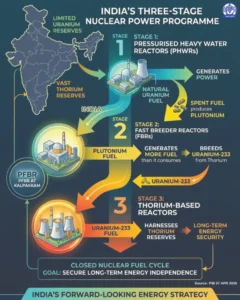
India’s Three-Stage Nuclear Programme
- The programme was designed by Homi J. Bhabha to maximise limited uranium resources and progressively utilise India’s thorium reserves.
Why Long-Term Management Matters
- Intergenerational safety: Some radioactive materials remain hazardous for very long periods.
- Financial liability: Waste treatment, storage and eventual disposal can continue long after a reactor stops generating electricity.
- Institutional continuity: Responsibilities must remain clear even after changes in ownership, plant closure or decommissioning.
- Public trust: Communities need transparent information and meaningful consultation before locating long-term waste facilities.
Current Significance
- The Prototype Fast Breeder Reactor (PFBR) at Kalpakkam has achieved first criticality, marking an important step towards Stage II of the programme.
- India already operates vitrification facilities, while research continues on geological disposal and actinide partitioning, which can reduce the volume and radiotoxicity of high-level waste.
- Nuclear regulation and safety oversight remain important as nuclear capacity expands; AERB performs the regulatory role under the existing framework.
Way Forward
- Establish clear long-term financial provisions for waste management and decommissioning.
- Strengthen independent safety assessment and continuous monitoring.
- Begin repository planning through site studies, geological research and public consultation.
- Clearly allocate waste-management responsibilities among the government, operators and regulators.
- Promote waste minimisation, reprocessing and advanced partitioning technologies.
Conclusion
India’s nuclear expansion must be matched by a cradle-to-grave waste-management system that protects public safety, preserves environmental security and prevents today’s nuclear benefits from becoming tomorrow’s burden.
A recent plea seeking the Attorney General’s consent to initiate criminal contempt proceedings against the Chief Election Commissioner has highlighted the statutory role of the Attorney General in contempt matters.
Constitutional Position
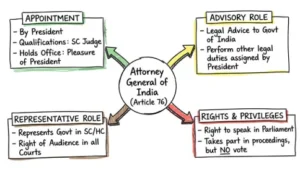
- Article 76 establishes the office of the Attorney General of India (AGI), the Union Government’s highest law officer.
- The President appoints a person qualified to be a Supreme Court judge as the Attorney General.
- The AGI must be an Indian citizen and should have been a High Court judge for 5 years, an advocate for 10 years, or be a distinguished jurist in the President’s opinion.
- The AGI holds office during the pleasure of the President; the Constitution provides no fixed tenure or specific removal procedure.
Functions and Duties
- Provides legal advice to the Government of India.
- Performs legal duties assigned by the President.
- Represents the Union Government before courts, particularly the Supreme Court.
- Has the right to appear in all courts in India.
Parliamentary Rights
- The AGI can speak and participate in proceedings of both Houses of Parliament, joint sittings and parliamentary committees of which they are a member.
- However, the AGI cannot vote in Parliament.
- They enjoy parliamentary privileges and immunities applicable to Members of Parliament.
Contempt-Related Role
- Under Section 15 of the Contempt of Courts Act, 1971, the Attorney General’s consent is required when a private person seeks to initiate criminal contempt proceedings in the Supreme Court.
- This acts as a procedural safeguard against frivolous contempt litigation.
Conclusion:
The Attorney General combines constitutional, advisory, courtroom and parliamentary functions, making the office central to the Union Government’s legal affairs.