Table of Contents
ToggleMarwar and Mewar Mughal Relations UPSC
The political Breach with Marwar and Mewar under Emperor Aurangzeb marked a critical turning point in the trajectory of the Mughal state. Departing from the inclusive alliance structure established by his predecessors, Aurangzeb’s interventionist measures disrupted decades of imperial stability. For civil services aspirants studying Medieval History UPSC, understanding Mughal Relations with Marwar and Mewar and the Rajput Policy of Aurangzeb is essential for mastering the political dynamics of late 17th-century South Asia.
Mughal–Rajput Relations Before Aurangzeb
- Initiated by Akbar through strategic matrimonial alliances, mutual respect, and high administrative integration (Mansabdari system).
- Sustained during the reigns of Jahangir and Shah Jahan, making Rajput ruling houses the premier military pillar of the empire.
- Ensured political stability across Northern India and provided the state with elite military commanders for expansionist campaigns.
Aurangzeb and the Breakdown of Mughal–Rajput Relations
- Shifted from mutual accommodation toward aggressive imperial centralization and direct intervention in succession disputes.
- Generated deep mistrust among traditional Rajput allies regarding the court’s respect for customary succession rights (tika).
- Alienated core military contingents, weakening the cooperative political consensus that sustained Mughal Rajput Relations.
Breach with Marwar
- Triggered in 1678 following the death of Maharaja Jaswant Singh of Marwar without a direct living heir at Jamrud.
- Escalated when Aurangzeb occupied Jodhpur, placed Marwar under direct imperial administration (Khalisa), and refused to immediately acknowledge Ajit Singh.
- Sparked the prolonged Rathore Rebellion Marwar led by Durgadas Rathore, who smuggled the infant prince out of Delhi to lead the Marwar Mughal Conflict.
Breach with Mewar
- Caused by Maharana Raj Singh of Mewar viewing the imperial annexation of Jodhpur as a direct threat to Rajput autonomy.
- Intensified when Mewar provided political refuge to Prince Ajit Singh and Rani Hadi, defying imperial decrees.
- Resulted in open warfare, initiating the Mewar Mughal Conflict as imperial forces invaded Mewar’s mountain strongholds.
Marwar and Mewar Join Hands
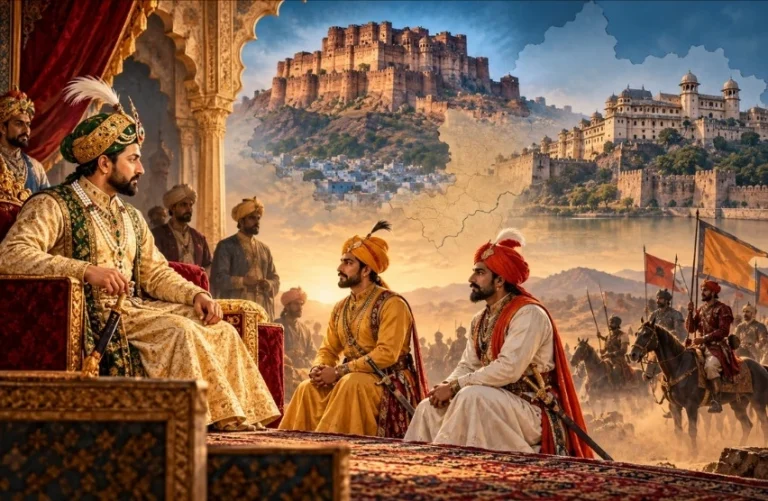
- Formed a formidable military coalition combining Rathore and Sisodia forces to present a united front against imperial overreach.
- Leveraged rugged Aravalli terrain to conduct effective guerrilla warfare, isolating imperial garrisons and supply lines.
- Induced Prince Akbar (Aurangzeb’s son) to rebel against his father in 1681 with combined Rajput backing.
Treaty and Settlement with Mewar
- Concluded in 1681 between Emperor Aurangzeb and Maharana Jai Singh (successor to Raj Singh) due to mounting pressures in the Deccan.
- Restored imperial diplomatic ties, with Mewar ceding select territories in lieu of paying Jizyah.
- Allowed Mewar to exit active hostilities, though deep structural mistrust toward central authority persisted.
Marwar Resistance and the Later Settlement
- Continued under the persistent leadership of Durgadas Rathore through decades of relentless guerrilla warfare across Marwar.
- Sustained organized Rajput Resistance to Mughals for nearly thirty years, tying down valuable provincial military contingents.
- Ended in 1707 after Aurangzeb’s death, when Maharaja Ajit Singh successfully reclaimed Jodhpur and secured imperial recognition.
Causes of the Mughal–Rajput Breach
- Imperial Interventionism: Arbitrary interference in the traditional succession rights of Rajput principalities.
- Fiscal and Ideological Shifts: Imposition of Jizyah (1679) and administrative pressure on Rajput lands.
- Strategic Miscalculation: Overestimating central military power while underestimating local resistance in the Aravallis.
Impact on the Mughal Empire
- Destroyed the vital military alliance with Rajput ruling houses, severely compromising imperial troop strength.
- Diverted critical military and financial resources away from Northern India right before the prolonged Deccan campaigns.
- Exposed internal political vulnerabilities, accelerating regional fragmentation covered under Mughal Empire UPSC.
Timeline – Marwar and Mewar Conflict
- December 1678: Death of Maharaja Jaswant Singh; imperial troops occupy Marwar.
- 1679: Escape of Prince Ajit Singh led by Durgadas Rathore; outbreak of the Rathore Rebellion Marwar.
- 1680: Formal entry of Mewar into the conflict; joint Marwar and Mewar UPSC coalition warfare against Mughals.
- 1681: Rebellion of Prince Akbar; signing of the peace treaty with Mewar; Aurangzeb’s departure for the Deccan.
- 1707: Death of Aurangzeb; Ajit Singh recaptures Jodhpur, ending the conflict.
Conclusion
The study of Marwar and Mewar Mughal Relations under Aurangzeb demonstrates the risks of abandoning cooperative statecraft for rigid centralization. The resulting Aurangzeb and Marwar and Aurangzeb and Mewar struggles fractured the empire’s core security foundation. Mastering Mughal Marwar Relations and Mughal Mewar Relations provides indispensable context for analyzing imperial decline in competitive examinations.
UPSC Prelims: PYQs & Practice Questions
Previous Year Questions (Prelims)
Q: With reference to the diplomatic and political rift between the Mughal Empire and the Rajput states of Marwar and Mewar during the reign of Aurangzeb, consider the following statements:
1. The immediate trigger for the breach with Marwar was the death of Maharaja Jaswant Singh at Jamrud in 1678 without an obvious heir present at court.
2. Durgadas Rathore played a pivotal role in safely evacuating Prince Ajit Singh from Delhi and leading the long-standing Rathore resistance against imperial forces.
Which of the statements given above is/are correct? (UPSC CSE Prelims 2018)
(a) 1 only
(b) 2 only
(c) Both 1 and 2
(d) Neither 1 nor 2
Answer: (c) Both 1 and 2
Explanation:
Statement 1 is correct: Maharaja Jaswant Singh died in 1678 while stationed at Jamrud. Since he left no surviving adult male heir at court, Aurangzeb occupied Jodhpur and placed Marwar under direct imperial administration (Khalisa), sparking deep resentment among the Rathore clan.
Statement 2 is correct: Durgadas Rathore famously rescued the newborn prince Ajit Singh and his mother from imperial confinement in Delhi, taking him to safety and sustaining a fierce, three-decade-long guerrilla struggle against Mughal control.
Q2: During the Mughal-Rajput conflict of 1679–1681, Maharana Raj Singh of Mewar decided to support Marwar against Emperor Aurangzeb primarily because:
(a) Mewar wanted to assert complete independence and annex trade ports along the Gujarat coastline.
(b) He perceived the imperial annexation of Marwar as a direct threat to the traditional autonomy and sovereign rights of all Rajput states.
(c) Aurangzeb offered Mewar full revenue collection rights over the province of Malwa.
(d) The Marathas had agreed to pay a large annual subsidy to Mewar for attacking Mughal territory.
Answer: (b) He perceived the imperial annexation of Marwar as a direct threat to the traditional autonomy and sovereign rights of all Rajput states.
Explanation:
Maharana Raj Singh realized that Aurangzeb’s high-handed intervention in Marwar's succession marked a fundamental shift away from the classic Mughal-Rajput partnership established under Akbar. Believing that Mewar would be the next target if Marwar fell, he gave refuge to Ajit Singh and formed a strategic coalition with the Rathores.
Practice Questions
Q: Regarding the Treaty of 1681 concluded between Emperor Aurangzeb and Maharana Jai Singh of Mewar, consider the following statements:
1. Mewar agreed to cede the parganas of Mandal, Pur, and Bednur to the Mughal Empire in lieu of paying Jizyah.
2. As per the settlement, the Mughals completely withdrew their military garrisons from Chittor and acknowledged Mewar's territorial integrity.
Which of the statements given above is/are correct?
(a) 1 only
(b) 2 only
(c) Both 1 and 2
(d) Neither 1 nor 2
Answer: (c) Both 1 and 2
Explanation:
Both statements are correct: Pressed by the rebellion of his own son, Prince Akbar, and the urgent need to march to the Deccan to contain the Marathas, Aurangzeb agreed to a diplomatic compromise with Maharana Jai Singh, successor to Raj Singh, in June 1681. Mewar ceded three border parganas in place of cash Jizyah payments, and imperial troops retreated from Mewar's core territories.
Q2: Which of the following was a major long-term consequence of the Mughal conflict with Marwar and Mewar (1679–1707)?
(a) Complete eradication of the Mansabdari system in Northern India.
(b) Disruption of the traditional alliance with the Rajputs, depriving the empire of its most loyal military commanders prior to the Deccan campaigns.
(c) Immediate conversion of all Rajput principalities into directly administered imperial subahs.
(d) Formation of a permanent political federation between the Rajputs and the English East India Company.
Answer: (b) Disruption of the traditional alliance with the Rajputs, depriving the empire of its most loyal military commanders prior to the Deccan campaigns.
Explanation:
The breach severely alienated the Rathores and Sisodias. Instead of leading Mughal armies in the Deccan as their ancestors had done under Akbar and Shah Jahan, prime Rajput contingents were tied down fighting imperial armies in the Aravallis or withheld their military cooperation altogether.
UPSC Mains – Previous Year & Practice Questions
Mains Previous Year Questions
Question: "Aurangzeb’s Rajput policy was marked by a departure from the traditional policy of accommodation and partnership initiated by Akbar." Critically analyze. (UPSC CSE Mains 2021)
Question: Evaluate the role played by Durgadas Rathore in sustaining the Marwar resistance against Mughal imperial power. (UPSC CSE Mains 2014)
Question: Trace the geopolitical factors that brought Marwar and Mewar into a combined military alliance against the Mughal Empire in 1679–1680. (UPSC CSE Mains 2008)
Question: Discuss how the conflict in Rajputana affected the military and administrative preparations of Aurangzeb for his prolonged campaigns in the Deccan. (UPSC CSE Mains 2002)
Question: "The Mughal-Rajput breach during the late 17th century was a symptom of growing centralizing tendencies rather than mere religious antagonism." Comment. (UPSC CSE Mains 1997)
Mains Practice Questions
[15 Marks | 250 Words]
Question: "The intervention in Marwar succession following Jaswant Singh's death proved to be a political blunder that destabilized the northern frontiers of the Mughal Empire." Elucidate.
[15 Marks | 250 Words]
Question: How far is it correct to argue that Prince Akbar’s rebellion of 1681 was the direct outcome of the deadlock created by the Mughal-Rajput conflict?
[15 Marks | 250 Words]
Question: Analyze the strategic and diplomatic features of the 1681 settlement with Mewar. Why did Marwar remain unpacified despite peace with Mewar?
Marwar and Mewar Mughal Relations-FAQs
Why did Mughal relations with Marwar deteriorate under Aurangzeb?
The conflict intensified after the death of Maharaja Jaswant Singh in 1678 without a direct living heir. Aurangzeb’s intervention in Marwar’s succession and administration triggered prolonged Rathore resistance.
Who led the Marwar resistance against the Mughals?
Durgadas Rathore emerged as the principal leader of the Rathore resistance. He helped protect the interests of the young Ajit Singh and continued the struggle against Mughal authority.
Why did Mewar join the conflict with the Mughals?
Mewar viewed Mughal intervention in Marwar as a threat to Rajput autonomy. Maharana Raj Singh supported the Marwar cause, leading to open conflict between Mewar and the Mughal Empire.
What was the significance of the Marwar–Mewar alliance?
The alliance combined Rathore and Sisodia resistance and used the difficult Aravalli terrain for guerrilla warfare. It also contributed to Prince Akbar’s rebellion against Aurangzeb in 1681.
What was the outcome of the Mughal–Rajput conflict?
Mewar reached a settlement with Aurangzeb in 1681, while Marwar resistance continued for much longer. After Aurangzeb’s death in 1707, Ajit Singh reclaimed Jodhpur and restored Rathore authority.