
CALLING OUT THE CRITICISM OF THE INDIAN JUDICIARY
TOPIC: (GS2) INDIAN POLITY: THE HINDU
Recently, Sanjeev Sanyal, Member of the Prime Minister’s Economic Advisory Council, called the judiciary the single biggest hurdle to India’s growth and achieving Viksit Bharat.
Misguided Criticism
- The judiciary is being blamed unfairly for delays and inefficiency in governance.
- Many critiques rely on myths—like short working hours or long vacations—without understanding the complexity and workload of judges.
- The claim that courts block economic growth oversimplifies structural problems in governance and law-making.
Real Challenges of the Judiciary
- Heavy Caseloads: India has one of the highest case backlogs globally, worsened by judicial vacancies.
- Under-Resourced: Courts lack sufficient infrastructure, staff, and technology support.
- Excessive Government Litigation: The Union and State governments are the largest litigants, often appealing routine cases unnecessarily, adding to delays.
- Poorly Drafted Laws: Many laws are vague or poorly designed, forcing courts to interpret ambiguities, which consumes time.
Example – Section 12A, Commercial Courts Act
- Pre-suit mediation is mandatory under this law.
- Criticized for inefficiency, but courts only enforce laws, not create them.
- The responsibility lies with lawmakers, not the judiciary.
Law-Making Issues
- Imprecise drafting leads to confusion and more litigation.
- New Income-Tax Act (2025) changes terms (e.g., “notwithstanding” → “irrespective”) without real simplification.
- Criminal law reforms rebrand old laws rather than offering meaningful change.
Misunderstood Court Hours
- Court sittings (10:30 a.m.–4 p.m.) hide the extensive off-bench work — reading files, writing judgments, studying precedents.
- Vacations are used for completing pending judgments, not leisure.
Where the Real Reform Is Needed
- Filling vacancies and improving infrastructure.
- Simplifying laws and reducing unnecessary litigation by government agencies.
- Introducing efficient case management systems and alternative dispute resolution.
Broader Perspective
- Judiciary’s role is not to speed up governance blindly but to safeguard constitutional principles.
- Labeling it as a hurdle undermines judicial independence and distracts from systemic flaws in legislation and administration.
Conclusion
Judicial reform is essential, but blaming the courts for all developmental delays is misguided. Real progress requires better law-making, reduced government litigation, adequate resources, and respect for judicial independence.
NOBEL PRIZE 2025 AND IMMUNE REGULATION
TOPIC: (GS3) SCIENCE AND TECHNOLOGY: THE HINDU
The 2025 Nobel Prize in Physiology or Medicine was awarded to Mary Brunkow, Fred Ramsdell, and Shimon Sakaguchi for discovering Regulatory T-cells (Tregs) and the gene FOXP3, which play a vital role in controlling autoimmunity and maintaining immune tolerance.
The Immune System
- The immune system protects the body from infections and abnormal cells.
- It consists of innate immunity (fast, non-specific) and adaptive immunity (specific, memory-based).
- T-cells, a type of white blood cell, help recognize and destroy harmful invaders.
- But sometimes, self-reactive T-cells mistakenly attack the body’s own tissues — leading to autoimmune diseases (e.g., Type 1 diabetes, lupus, multiple sclerosis).
- To prevent this, the body needs mechanisms of self-tolerance — the ability to distinguish self from non-self.

Key Findings by the Laureates:
- Shimon Sakaguchi (1995): Discovered a special subset of CD4⁺ T-cells called Regulatory T-cells (Tregs) that suppress immune overreactions. Removing these cells in mice caused multiple autoimmune disorders.
- Mary Brunkow & Fred Ramsdell: Studied scurfy mice and identified the FOXP3 gene (on the X chromosome) as essential for Treg function. Found that mutations in FOXP3 lead to immune system collapse.
- Human studies later showed that FOXP3 mutations cause severe autoimmune disease in infants (e.g., IPEX syndrome).
Significance of the Discovery
- Established that self-tolerance depends not only on deleting harmful cells but also on active regulation by Tregs.
- Introduced the concept of the immune system as a balance between activation and restraint, not merely an “on/off” switch.
Modern Applications
- Autoimmune diseases: Experimental therapies aim to increase or stabilize Tregs to control inflammation without suppressing overall immunity.
- Organ Transplants: Engineered Tregs are infused to help the body accept transplanted organs.
- Cancer Treatment: Scientists try to block or reprogram Tregs in tumors to boost anti-cancer immunity.
- Gene Therapy & Cell Therapy: Target FOXP3 pathways to restore immune balance.
Challenges & Ethical Issues
- Translating these discoveries into safe, affordable therapies remains difficult.
- High cost of cell-based treatments may limit access, raising equity and policy concerns.
- The immune system’s complexity means that manipulating one part may have unintended effects.
Broader Impact
- Redefined immunology by showing the immune system as a dynamic ecosystem.
- Highlighted the role of industry research (Celltech Chiroscience) in fundamental discoveries.
- Paved the way for personalized and precision immunotherapies.
T-CELLS
Type of White Blood Cell:
T-cells (or T-lymphocytes) are a type of white blood cell that play a central role in the body’s adaptive immune system — they recognize and respond to specific pathogens.
- Develop in Thymus:
They are produced in the bone marrow but mature in the thymus gland, which is why they’re called T-cells (“T” for thymus). - Key Functions:
- Helper T-cells (CD4⁺) activate other immune cells.
- Cytotoxic T-cells (CD8⁺) kill infected or cancerous cells.
- Regulatory T-cells (Tregs) prevent autoimmunity by controlling excessive immune responses.
Conclusion
The Nobel-winning discovery of Tregs and FOXP3 transformed our understanding of immune regulation. It opened new paths for treating autoimmune disorders, improving transplant outcomes, and designing cancer therapies.
REFORMING PASSIVE EUTHANASIA IN INDIA
TOPIC: (GS2) INDIAN POLITY: THE HINDU
The U.K. House of Commons recently passed the Terminally Ill Adults (End of Life) Bill, permitting physician-assisted dying under strict conditions.
Understanding Euthanasia
- Euthanasia means intentionally ending life to relieve suffering.
- Active Euthanasia – deliberate act to end life (illegal in India).
- Passive Euthanasia – withdrawing or withholding life support when treatment only prolongs suffering (legal in India).
Legal Status in India
- Aruna Shanbaug Case (2011) – allowed passive euthanasia under strict guidelines.
- Common Cause v. Union of India (2018) – upheld right to die with dignity as part of Article 21; legalised advance directives (living wills).
- Article 21 – Right to Life includes Right to Die with Dignity, but not the right to be killed.
- Active Euthanasia remains prohibited under Section 306 & 309 IPC.
Current Framework
- Problem: Process is slow, complex, and inaccessible.
- Many families take informal decisions, putting doctors in legal risk.
- The law’s intent is noble, but implementation is weak.
Reform Passive Euthanasia
- Simplify Procedures Using Technology: Create a National Digital Portal for Advance Directives, linked with Aadhaar for verification. Allow online creation, update, or revocation.
- Local Decision-Making: Empower Hospital Ethics Committees (senior doctors + palliative expert + neutral member) to decide within 48 hours.
- Oversight and Safeguards: Replace ineffective ombudsmen with digital dashboards monitored by medical auditors.
- Training & Awareness: Add end-of-life care in medical curriculum. Conduct public campaigns on living wills and patients’ rights.
Constitutional and Ethical Perspective
- Article 21 – Right to Life includes Dignity in Death.
- Article 14 – Equality; safeguards against arbitrary denial of rights.
- Article 47 – State’s duty to improve public health includes compassionate care.
- Ethical principle: Autonomy + Beneficence + Non-Maleficence.
Conclusion
India should not rush toward active euthanasia, but must strengthen passive euthanasia through digital reforms, local ethics oversight, and humane safeguards. This approach respects Indian cultural values, ensures dignity, and aligns with constitutional morality.
CRIMES AGAINST CHILDREN SURGE IN ASSAM, RAJASTHAN, AND KERALA
TOPIC: (GS1) SOCIAL ISSUES: THE HINDU
The NCRB’s 2023 data shows a sharp rise in recorded crimes against children in Assam, Rajasthan, and Kerala, with cases nearly doubling in these States compared to the 2018–2022 average.
National Overview
- Across India, crimes against children rose by 25% in 2023 compared to the average of 2018–2022.
- However, Assam (+100%), Rajasthan (+70%), and Kerala (+106%) showed the highest increases.
- The increase may indicate better reporting and data classification, not necessarily a surge in actual crime.
State-Wise Trends and Reasons
Assam
- Cases rose from ~5,100 to 10,000+ in 2023.
- Major driver: State crackdown on child marriage.
- Cases under the Prohibition of Child Marriage Act (2006) jumped from ~150 per year to 5,267 in 2023.
- 52% of all crimes against children in Assam in 2023 were child marriage cases.
- Indicates policy-led reporting increase rather than a rise in violence.
Rajasthan
- Cases increased from ~6,200 to 10,500+ in 2023.
- Key reasons:
- Rise in Kidnapping & Abduction cases: Their share grew to 54% of total crimes against children.
- Reclassification under POCSO Act (2012):
- Earlier, many child rape cases were filed under IPC Section 376.
- In 2022–23, cases were shifted to POCSO Sections 4 & 6, leading to more accurate data.
- Cases rose from 2,700 to 3,500, showing both better classification and possible increase.
Kerala
- Cases more than doubled from ~2,800 to 5,900.
- Driven by:
- Increase in POCSO cases.
- Improved classification under specific POCSO provisions.
- Possibly enhanced awareness and reporting mechanisms.
Challenges
- Underreporting still persists in many areas.
- Data inconsistencies due to poor classification.
- Slow trials and low conviction rates reduce deterrence.
- Socio-economic factors like poverty, illiteracy, and gender bias exacerbate risks.
Way Forward
- Strengthen child protection units and police training under POCSO.
- Improve data management and digital reporting systems.
- Promote awareness among parents and communities.
- Expand panchayat-level monitoring for child marriage prevention.
- Ensure speedy justice through fast-track POCSO courts.
LEGAL FRAMEWORK
- POCSO Act, 2012 – Protects children from sexual offences.
- Prohibition of Child Marriage Act, 2006 – Bans child marriages.
- IPC Sections (363-369) – Deal with kidnapping and abduction.
- Article 15(3) – Allows special provisions for children.
- Article 39(e) & (f) – Directs State to protect children from abuse and ensure healthy development.
Conclusion
The surge in cases in Assam, Rajasthan, and Kerala reflects stronger enforcement and reporting rather than only an increase in crimes. Strengthening institutional capacity, data accuracy, and community awareness is essential to ensure child protection, justice, and policy effectiveness.
CAN THIRD PARTIES BE LIABLE FOR MARITAL DISRUPTION?
TOPIC: (GS2) INDIAN POLITY: THE HINDU
Recently, the Delhi High Court, in Shelly Mahajan vs. M.S. Bhanushree Bahl & Anr (2024), allowed a civil suit by a wife seeking damages from her husband’s partner for allegedly interfering in her marriage, reviving the “Alienation of Affection” (AoA) doctrine.
What is Alienation of Affection (AoA)?
- AoA is a common law “heart-balm” tort that lets a spouse sue a third party (like a lover) for wrongfully disrupting a marriage and causing loss of love, companionship, and consortium.
- It treats marriage as a legally protected relationship, and interference as a civil wrong (tort).
- Though not codified in Indian law, courts have occasionally recognised it in principle.
Key Judgments:
- Pinakin Mahipatray Rawal v. State of Gujarat (2013): SC observed that alienation of affection by a third party can amount to an intentional tort.
- Indra Sarma v. V.K.V. Sarma (2013): SC noted that even children may claim damages for loss of parental affection due to third-party interference.
Position in the United States
- AoA suits still exist in a few states — North Carolina, Mississippi, South Dakota, Utah, New Mexico, Hawaii.
- To succeed, a spouse must prove:
- Genuine love existed in the marriage.
- The affection was lost.
- A third party’s malicious conduct caused the loss.
- Most U.S. states have abolished the tort, viewing it as outdated and prone to misuse.
Indian Context – Joseph Shine Judgment (2018)
- The Supreme Court in Joseph Shine v. Union of India decriminalised adultery, holding it as a private matter and not a criminal offence.
- However, it remains a civil wrong — a valid ground for divorce or compensation under tort law.
- The judgment did not prohibit civil remedies like AoA suits.
Delhi High Court’s View (2024)
- Held that Joseph Shine only removed criminal punishment; it did not give immunity from civil liability.
- Recognised a spouse’s right to sue a third party for intentional interference in marriage.
- Clarified civil courts, not family courts, have jurisdiction over AoA claims, as it’s an independent tort, not a matrimonial dispute.
- Established a three-fold test for AoA:
- Intentional and wrongful conduct by the third party.
- Direct link between conduct and marital disruption.
- Measurable loss to the aggrieved spouse.
Legal Position in India
- Adultery: Decriminalised (Joseph Shine, 2018).
- AoA: Not expressly recognised, but possible under tort law.
- Remedies: Divorce (family court), Compensation (civil court).
- No statutory bar against suing a third party for intentional harm to marriage.
Way Forward
- Clear legislative guidance on tort-based marital claims to avoid misuse.
- Awareness on privacy rights and personal autonomy.
- Balanced approach — protect marital sanctity without moral policing.
- Encourage mediation before litigation to preserve family harmony.
Conclusion
The Alienation of Affection claim recognises a spouse’s legal interest in marital companionship, allowing compensation where a third party intentionally disrupts it — marking a new intersection of tort and family law in India.
ADVOCATE THROWS PAPERS AT CJI-LED BENCH, RAISES SLOGANS
TOPIC: (GS2) INDIAN POLITY: THE HINDU
An advocate Rakesh Kishore threw papers and raised slogans before a Bench headed by Chief Justice of India (CJI) D.Y. Chandrachud and Justice K. Vinod Chandran.
The Incident
- The event took place during oral mentioning before the CJI-led Bench on Monday.
- Advocate Rakesh Kishore flung a bundle of papers and allegedly tried to remove his shoes to hurl them, while raising slogans about “Sanatana”.
- The CJI remained calm, telling lawyers to ignore the disruption and continue proceedings.
- The security personnel immediately removed the individual from the courtroom.
Context
- The act is reportedly linked to social media outrage over CJI Gavai’s remarks in the Vishnu Idol Restoration case, which were distorted online.
- CJI later clarified in open court that he respects all faiths and upholds true secularism.
Disciplinary Action
- The Bar Council of India issued an interim suspension of advocate Kishore under the Advocates Act, 1961 and BCI Rules.
- The Supreme Court Advocates-on-Record Association (SCAORA) and Supreme Court Bar Association (SCBA) condemned the act as unprofessional and a violation of judicial decorum.
- They urged the Court to consider contempt proceedings to protect judicial independence.
Legal and Constitutional Aspects
- Article 129: Supreme Court has power to punish for contempt to uphold its dignity.
- Article 145: Empowers SC to frame rules of procedure.
- Advocates Act, 1961: Advocates must adhere to professional conduct and ethics.
- Misconduct can lead to suspension or disbarment by the Bar Council.
Role and Powers of the Chief Justice of India
- Head of the Indian Judiciary and Supreme Court.
- Responsible for allocation of cases, formation of Benches, and administrative supervision of the judiciary.
- Serves as a symbol of judicial independence and constitutional authority.
- Ensures discipline, decorum, and respect for the rule of law in court.
Significance of the Incident
- Reflects growing public hostility and misinformation targeting judges.
- Undermines judicial decorum and the Bench-Bar relationship.
- Necessitates stronger security measures and public awareness on judicial respect.
Way Forward
- Strict enforcement of BCI ethical rules.
- Swift disciplinary actions to deter future misconduct.
- Public sensitisation on judicial independence and decorum.
- Use of contempt powers in extreme cases to maintain order.
Conclusion
The Supreme Court incident highlights the urgent need to safeguard judicial dignity and uphold constitutional respect for courts. The CJI’s calm response reaffirmed faith in judicial restraint, while the BCI’s prompt suspension demonstrated zero tolerance toward professional misconduct.
PROMOTING ORGANIC FARMING IN INDIA
TOPIC: (GS3) ECONOMY: THE HINDU
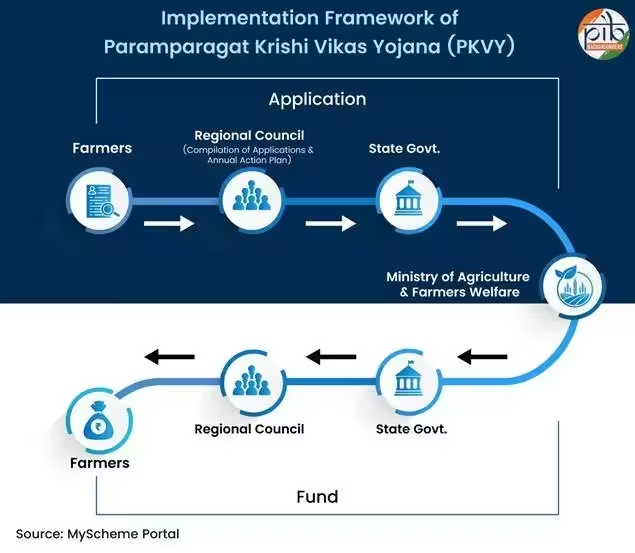
The Paramparagat Krishi Vikas Yojana (PKVY), launched in 2015 under the National Mission for Sustainable Agriculture (NMSA), continues to promote chemical-free farming and organic farmer clusters across India.
About Organic Farming
- Definition: A farming system that avoids synthetic fertilizers and pesticides, relying instead on natural inputs such as compost, crop residues, and farmyard manure.
- Goal: To maintain soil fertility, improve ecosystem balance, and ensure healthy food production.
Status of Organic Farming in India
- India ranks 4th globally in certified organic area (IFOAM, 2022).
- Madhya Pradesh has the largest organic-certified area, followed by Maharashtra, Rajasthan, Gujarat, and Karnataka.
- Sikkim is the first fully organic state.
- India ranks 1st in the number of organic farmers.
- Organic exports reached $708 million (2022–23), with high potential to grow in the $138 billion global market.
Benefits of Organic Farming
- Healthy Produce: Free from chemical residues, rich in nutrients.
- Soil Regeneration: Enhances organic matter, microbial activity, and fertility.
- Economic Advantage: Premium pricing, niche markets, lower long-term input costs.
- Climate Resilience: Encourages carbon sequestration and reduces greenhouse gases.
- Biodiversity Support: Promotes habitat for beneficial species.
Organic Certification Systems
- National Programme for Organic Production (NPOP):
- Managed by the Ministry of Commerce and Industry.
- Based on third-party certification for export markets.
- Participatory Guarantee System (PGS-India):
- Managed by Ministry of Agriculture.
- Community-based, peer-reviewed certification.
- Jaivik Bharat Logo: Mandatory for certified organic products in the domestic market.
About PKVY
- Promotes end-to-end organic support — production, certification, and marketing.
- Cluster Approach: Farmers organized into 20-hectare groups for uniform practices.
- Financial Aid: ₹31,500 per hectare for 3 years.
- Focus on low-cost, eco-friendly methods and farmer-led collectives.
Complementary Schemes
- MOVCDNER: Focused on organic farming in North Eastern States.
- Jaivik Kheti Portal: Online platform for marketing organic produce.
- Large Area Certification (LAC): Quick certification for chemical-free regions.
Way Forward
- Expand PKVY clusters into large organic belts.
- Invest in local research, training, and innovation.
- Encourage rural youth in organic-based entrepreneurship and eco-tourism.
150TH ANNIVERSARY OF VANDE MATARAM
TOPIC: (GS1) INDIAN HISTORY: PIB
The Union Cabinet has announced nationwide celebrations marking the 150 years of the composition of ‘Vande Mataram’, India’s national song, to honor its cultural and historical legacy.
About Vande Mataram
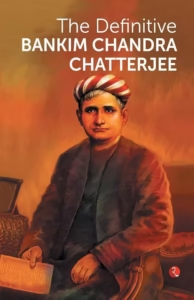
- Composer: Written by Bankim Chandra Chatterjee in Sanskrit.
- First Appearance: Featured in his famous novel Anandamath (1882).
- First Public Recital: Sung by Rabindranath Tagore at the 1896 session of the Indian National Congress, giving it national recognition.
- The song celebrates Mother India and became a symbol of patriotism during the freedom struggle.
Constitutional and Legal Status
- Declared as National Song alongside Jana Gana Mana through a Presidential Order in 1950.
- Article 51A(a) of the Constitution requires respect for the National Anthem, but not mandatory respect for the National Song — reflecting constitutional sensitivity.
Historical Significance
- Served as a rallying call for freedom fighters and revolutionaries.
- Inspired unity and national identity against British colonial rule.
Conclusion
The 150th anniversary offers an opportunity to honor India’s cultural heritage, revive patriotic spirit, and educate youth about the song’s role in shaping national consciousness.