

Table of Contents
ToggleELECTION COMMISSION APPOINTMENTS AND SUPREME COURT BENCH DEBATE
TOPIC: (GS2) POLITY: THE HINDU
On 23 September 2026, a two-judge Supreme Court Bench gave a split opinion on whether challenges to the 2023 law governing appointments to the Election Commission require consideration by a five-judge Constitution Bench.
What is the Immediate Issue?
- The Chief Election Commissioner and Other Election Commissioners Act, 2023 provides for appointments on the recommendation of a committee consisting of:
- Prime Minister;
- Leader of Opposition in Lok Sabha; and
- Union Cabinet Minister nominated by the Prime Minister.
- This replaced the temporary arrangement created in Anoop Baranwal v. Union of India (2023), where the third member was the Chief Justice of India (CJI) until Parliament enacted a law.
- Petitioners have challenged the new arrangement, raising questions concerning the independence of the Election Commission under Article 324.
Why Did the Supreme Court Bench Differ?
- Article 145(3) requires at least five judges where a case involves a substantial question of law concerning interpretation of the Constitution.
- Justice Dipankar Datta’s view: Anoop Baranwal had already laid down relevant constitutional principles; therefore, the present case primarily required applying existing law to the 2023 Act.
- Justice Satish Chandra Sharma’s view: The validity of the new legislation had never been authoritatively decided and raised substantial constitutional questions warranting a Constitution Bench.
- Both judges ultimately placed the matter before the CJI for considering an appropriate larger Bench.
Broader Constitutional Concerns
- Article 141 – Judicial precedent: Law declared by the Supreme Court is binding on all courts. Consistent application of larger-Bench judgments promotes legal certainty.
- Electoral independence: An independent Election Commission is essential for free and fair elections, which are central to constitutional democracy.
- Timely justice: Long delays in constitutional cases may create a fait accompli, where contested laws operate for years before their validity is finally settled.
Supreme Court’s Structural Challenge
- The Supreme Court performs two major functions—constitutional adjudication and final appellate review.
- A heavy volume of appeals and Special Leave Petitions can reduce the time available for Constitution Benches.
- Consequently, questions concerning fundamental rights, federalism or institutional independence may remain pending for long periods.
Way Forward
- Establish a permanent Constitution Bench for important constitutional questions.
- The Law Commission’s 229th Report (2009) proposed a Constitution Bench in Delhi alongside regional Cassation Benches dealing with appellate matters.
- Adopt transparent rules for Bench formation and case prioritisation.
- Strengthen adherence to stare decisis, particularly decisions of larger Benches.
- Prioritise time-sensitive constitutional disputes whose delayed resolution may affect democratic institutions.
Conclusion
A strong constitutional court requires not merely judicial independence, but an institutional architecture that delivers authoritative constitutional answers consistently and on time.
REVIEWING MODEL BILATERAL INVESTMENT TREATY (BIT)
TOPIC: (GS2) POLITY: THE HINDU
India is reviewing its 2015 Model Bilateral Investment Treaty (BIT), after the Union Budget 2025-26 announced plans to make the framework more investor-friendly.
What is a Bilateral Investment Treaty (BIT)?
- A BIT is an agreement between two countries that lays down rules for protecting investments made by investors of one country in the other.
- It generally covers protection against unlawful expropriation, non-discrimination, transfer of funds and mechanisms for settling investment disputes.
- A Model BIT serves as India’s reference framework during negotiations; individual treaties can differ depending on the negotiating partner.
Why Did India Adopt the 2015 Model BIT?
- India faced several investor-State disputes under its older treaties.
- The White Industries v. India (2011) arbitration highlighted risks arising from broadly worded investment protections.
- Consequently, the 2015 Model adopted a cautious approach, including:
- a narrower definition of investment;
- carefully defined investor protections;
- safeguards for the government’s regulatory powers; and
- requirement to pursue domestic remedies for five years before international arbitration.
- The objective was to reduce arbitrary treaty claims while preserving legitimate investor protection.
Why is a Review Needed?
- Changing Indian practice: Recent agreements indicate greater flexibility. For example, the India-UAE BIT treats local remedies as pursued after at least three years, subject to treaty conditions, compared with five years in the 2015 Model.
- Investor confidence: Lengthy domestic litigation before accessing arbitration may increase uncertainty and transaction costs.
- Changing global framework: UNCTAD notes that newer investment treaties increasingly emphasise investment facilitation, cooperation and sustainable development, while relying relatively less on traditional Investor-State Dispute Settlement (ISDS).
- Development needs: India requires long-term foreign investment in infrastructure, manufacturing, clean energy and advanced technologies.
What Should the Revised Model Address?
- Most-Favoured-Nation (MFN) clause: If included, its scope should be precisely defined so investors cannot automatically import more favourable dispute-settlement provisions from India’s other treaties.
- Investor obligations: Treaties can incorporate compliance with domestic law and responsible business, environmental and social standards. UNCTAD identifies investor obligations as an increasing feature of modern investment frameworks.
- Dispute resolution: A shorter local-remedy period, mediation and early consultation could resolve disputes before costly international arbitration.
- Regulatory space: Clear exceptions should protect legitimate government action relating to public health, environment, taxation, financial stability and national security.
- Clear protection standards: Terms relating to expropriation and treatment of investors need precise drafting to reduce conflicting interpretations.
- Sustainable investment: Investment protection should complement India’s developmental and environmental priorities rather than operate separately from them.
Broader Significance for India
- Economic: A predictable treaty regime can support stable foreign investment.
- Legal: Clear drafting can reduce expensive international arbitration.
- Governance: Investor protection must coexist with Parliament’s and government’s ability to pursue public-interest regulation.
- Strategic: India can use its growing economic weight to help shape emerging global investment rules rather than merely adopt existing models.
Way Forward
- India needs a balanced Model BIT combining predictable investor protection, efficient dispute prevention, responsible-investor obligations and adequate policy space for the State.
- This reflects the wider global shift towards investment treaties aligned with sustainable development.
Conclusion
India’s revised Model BIT should make investment both secure and responsible—protecting genuine investors without compromising the sovereign policy space required for inclusive and sustainable development.
TIGER REINTRODUCTION PROGRAMME
TOPIC: (GS3) ENVIRONMENT: THE HINDU
India has begun a phased tiger reintroduction programme in Buxa Tiger Reserve, West Bengal, with tigress T138 brought from Bihar’s Valmiki Tiger Reserve.
About Buxa Tiger Reserve
- Located in northern West Bengal, Buxa was declared a Tiger Reserve in 1983.
- It forms part of a wider transboundary landscape connected with forests of Bhutan and Assam, making wildlife corridors crucial for long-term conservation.
- Over time, habitat degradation, fragmentation, land-use changes and declining prey availability weakened its capacity to sustain a resident tiger population.
Why Reintroduce Tigers?
- Reintroduction seeks to establish a viable, breeding and self-sustaining tiger population where local populations have disappeared.
- It can restore the tiger’s role as an apex predator, contributing to ecological balance.
- India has previously used tiger reintroduction to rebuild populations in reserves such as Sariska and Panna.
- However, translocation is effective only when the underlying causes of local extinction have been addressed.
Key Ecological Challenges
- Poor prey base: Tigers require adequate populations of natural prey such as chital and other ungulates.
- Habitat fragmentation: Roads, railway lines, settlements and other infrastructure can obstruct animal movement and increase mortality.
- Habitat quality: Ecological restoration must maintain suitable grasslands and vegetation needed by herbivores.
- Human-wildlife conflict: Tigers moving outside reserve boundaries can threaten livestock and increase conflict with surrounding communities.
- Genetic viability: Connectivity with neighbouring forests is necessary to permit natural dispersal and maintain genetic diversity.
Conservation vs Community Rights
- Tiger conservation cannot be viewed only through the idea of an inviolate core area.
- Forest-dependent and tribal communities may depend on forests for livelihoods, cultural practices and ecosystem resources.
- Community-based conservation can create local support through livelihood opportunities, compensation, ecotourism and conflict-management mechanisms.
- Government conservation policy itself recognises community involvement as an important component of tiger protection.
India’s Tiger Conservation Framework
- Project Tiger, launched in 1973, provides financial and technical support for habitat and tiger conservation. India’s estimated average tiger population reached 3,682 in 2022.
- The National Tiger Conservation Authority (NTCA) provides scientific and management guidance to tiger-range States.
- Under Section 38V of the Wildlife (Protection) Act, 1972, Tiger Conservation Plans must protect tigers and their prey while also maintaining ecological connectivity between protected areas.
Way Forward
- Adopt landscape-level conservation, extending protection beyond reserve boundaries to wildlife corridors.
- Make railway, road and other infrastructure wildlife-sensitive through crossings and scientific impact assessment.
- Strengthen camera-trap monitoring, genetic studies and long-term tracking of released animals.
- Ensure local communities become conservation partners, with rapid compensation for livestock losses and sustainable livelihood support.
- Shift policy from reactive rescue to preventive conservation, identifying ecological decline before wildlife populations disappear.
Conclusion
Buxa’s real success will not be measured by the number of tigers released, but by whether a healthy habitat, secure corridors and supportive communities allow tigers to survive and reproduce naturally.
INDIA’S STAND ON GLOBAL TRADE ISSUES
TOPIC: (GS2) INTERNATIONAL RELATIONS: THE HINDU
At the 2026 G20 Trade Ministers’ Meeting in Milwaukee, U.S., India stated that it has no structural excess capacity in the sectors under discussion and reaffirmed its commitment to eliminating forced labour from supply chains.
What is Structural Excess Capacity?
- It arises when an economy develops production capacity persistently beyond sustainable domestic and global demand, particularly where production is supported by market-distorting policies.
- Such excess output may enter foreign markets at low prices, potentially hurting producers and employment in importing countries.
- India argued that industrial capacity itself should not be treated as a problem; concern should focus on distortions such as hidden subsidies, dumping and predatory pricing.
India’s Position
- India maintains that its expanding manufacturing capacity is driven substantially by domestic demand and development requirements.
- Developing economies require sufficient policy space for industrialisation; supply-chain diversification should not become a justification for protectionism.
- Where unfair trade practices exist, India favours established WTO-compatible instruments such as anti-dumping and countervailing duties, supported by evidence and review mechanisms.
Forced Labour and India
- Article 23 of the Constitution prohibits forced labour and trafficking in human beings.
- India has ratified the ILO’s Forced Labour Convention, 1930 (No. 29) and Abolition of Forced Labour Convention, 1957 (No. 105).
- The government stated that India amended its Foreign Trade Policy in July 2026 to prohibit imports of goods produced through forced labour.
- India supports eliminating forced labour globally but argues that border restrictions should rely on specific and verifiable evidence, due process and multilateral rules rather than broad assumptions about countries or industries.
Why Does the Issue Matter for India?
- Export competitiveness: Additional tariffs can raise the cost of Indian products in major markets.
- Global supply chains: Exporters increasingly need credible traceability of labour and sourcing practices.
- Development concerns: Broad restrictions on manufacturing capacity could constrain industrialisation in emerging economies.
- Multilateralism: Unilateral tariffs raise wider questions regarding the effectiveness and relevance of the WTO-centred trading system.
- Labour standards: Strong domestic enforcement against forced labour can simultaneously protect workers and strengthen India’s reputation as a reliable manufacturing partner.
Way Forward
- India should strengthen supply-chain traceability, labour inspections and corporate due diligence, while improving transparency on subsidies and industrial support.
- At the global level, India can advocate evidence-based, non-discriminatory and WTO-consistent trade remedies, while supporting the ILO’s central role in international labour standards.
Conclusion
India’s challenge is to combine worker protection and fair competition with sufficient policy space for industrialisation, while defending a predictable and rules-based global trading system.
CHIME TELESCOPE
TOPIC: (GS3) SCIENCE AND TECHNOLOGY: THE HINDU
An international research team, including scientists from Bengaluru’s Raman Research Institute (RRI), has detected the faint radio signature of hydrogen from about nine billion years ago using the CHIME telescope.
About CHIME Telescope
- CHIME stands for Canadian Hydrogen Intensity Mapping Experiment.
- It is a radio telescope located at the Dominion Radio Astrophysical Observatory in British Columbia, Canada.
- It was designed primarily to map neutral hydrogen across large regions of the Universe.
- Unlike conventional dish telescopes, CHIME has no moving parts.

Key Features
- It consists of four large cylindrical reflectors fitted with over 1,000 antenna elements.
- It observes radio frequencies between 400 and 800 MHz.
- As the Earth rotates, different portions of the sky pass over the telescope, allowing it to survey roughly half the sky each day.
- A powerful digital correlator processes enormous quantities of incoming signals and enables the telescope to focus electronically.
Scientific Importance
- Hydrogen mapping: Neutral hydrogen emits a characteristic 21-cm radio signal, which scientists use to trace matter across cosmic history.
- Universe evolution: Mapping distant hydrogen can help researchers understand how large-scale structures such as galaxies developed.
- Fast Radio Bursts: CHIME has also become an important instrument for detecting FRBs—extremely brief and powerful radio signals from distant cosmic sources.
- Indian contribution: Participation by RRI researchers highlights India’s growing role in international radio-astronomy research.
Conclusion
CHIME demonstrates how radio astronomy can look billions of years into the cosmic past and help reconstruct the evolution of our Universe.
CHINA’S NEW MILITARY FACILITY IN LAOS
TOPIC: (GS3) SEQURITY: THE HINDU
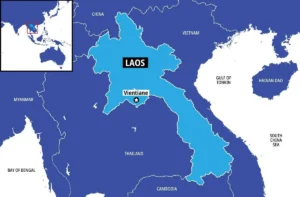
China and Laos have made operational a Joint Support and Training Centre and aviation academy at Ban Keun, around 50 km north of Vientiane.
About the Facility
- Located at Ban Keun in Laos, the complex includes a paved runway, taxiway, apron and supporting buildings.
- Its stated purpose is to train Lao Air Force pilots and strengthen defence cooperation between the two countries.
- China and Laos will jointly maintain the facility; however, the exact number of Chinese personnel and military assets stationed there has not been publicly specified.
Strategic Significance
- Expanding military footprint: China already operates a logistics base in Djibouti and has a joint support facility at Cambodia’s Ream Naval Base.
- Mainland Southeast Asia: A sustained presence in landlocked Laos can deepen China’s military relationship with a country bordering Thailand, Vietnam, Cambodia, Myanmar and China.
- Power projection: The airfield could potentially provide logistical support for Chinese military aircraft, although the future scale and nature of deployments remain uncertain.
- Regional geopolitics: Thailand and other regional actors are monitoring developments as strategic competition involving China and the U.S. continues across the Indo-Pacific.
- China-Laos ties: The development complements growing economic, infrastructure and defence cooperation between Beijing and Vientiane.
Implications for India
- China’s expanding overseas military access adds another dimension to its growing strategic presence in India’s wider neighbourhood.
- India may need to deepen defence and connectivity partnerships with ASEAN, strengthen engagement through its Act East Policy, and closely monitor changes in the regional security architecture.
- It also underlines the growing strategic importance of mainland Southeast Asia in the wider Indo-Pacific.
Conclusion
The Ban Keun facility illustrates China’s gradual shift from primarily economic influence towards a broader security presence in Southeast Asia, making regional strategic balance increasingly important for India.