Table of Contents
Toggle17th Century India UPSC
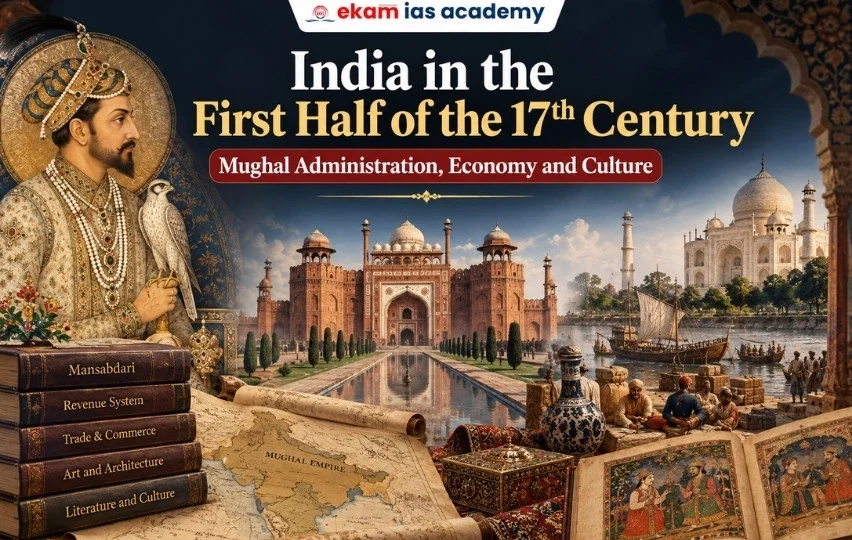
The period of India in the First Half of the 17th Century represented the absolute zenith of Mughal authority, artistic brilliance, and economic prosperity. Under the consecutive reigns of Emperors Jahangir (1605–1627) and Shah Jahan (1628–1658), Mughal India in 17th Century history transformed into a global economic powerhouse. Studying 17th Century Indian History UPSC modules highlights how administrative maturity and territorial growth defined this vibrant era within Medieval India UPSC.
Political Conditions in India
- Imperial authority reached unprecedented centralization under the rule of Jahangir and Shah Jahan across Northern and Central India.
- Mughal Administration 17th Century frameworks functioned through an expanded Mansabdari network, maintaining domestic peace and revenue collection.
- The rise of influential court factions, including Nur Jahan’s Junta, heavily shaped political appointments and succession dynamics.
Mughal Expansion and the Deccan
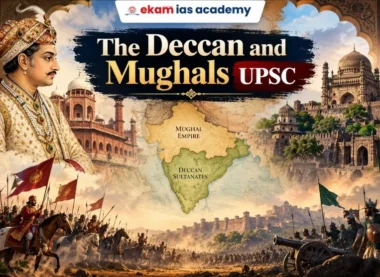
- Executed a forward-leaning Mughal Deccan Policy aimed at dismantling the independent Deccani Sultanates.
- Extinguished the Nizam Shahi dynasty of Ahmadnagar in 1636 and integrated its northern territories into the empire.
- Secured imperial suzerainty over Bijapur and Golconda through the Treaties of 1636, marking significant Mughal Empire Expansion.
Mughal Foreign Relations
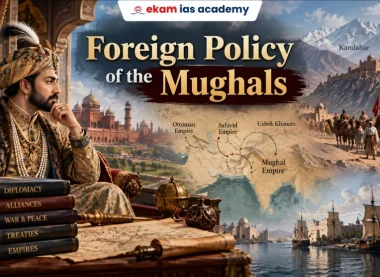
- Sustained active Mughal Foreign Relations with Safavid Persia, the Ottoman Empire, and the Uzbek Khanates of Central Asia.
- Controlled key strategic trade centers, though protracted military rivalries over Qandahar strained resources along the Northwest frontier.
- Extended imperial diplomacy to incoming European Trading Companies in India, granting trading privileges to foreign merchants.
Economic Conditions
- Agriculture thrived as the Zabt revenue system was systematically expanded across newly conquered imperial provinces.
- Domestic and foreign commerce expanded as Portuguese Dutch English and French in India established coastal factories at Surat, Masulipatnam, and Pulicat.
- Produced world-renowned textiles, indigo, and spices, making India in 17th Century trade networks central to global bullion inflows.
Social Conditions
- Society was highly stratified, featuring an elite Mughal and Rajput nobility ruling over agrarian, artisan, and merchant communities.
- Urban centers like Agra, Delhi, Lahore, and Surat grew into thriving hubs of craft production, trade, and culture.
- Deepened social integration by absorbing diverse Deccani, Maratha, and regional elites into the imperial administrative hierarchy.
Religious and Cultural Developments
- Preserved the tolerant policies of Sulh-i-Kul, though court rituals reflected a subtle shift toward Islamic orthodoxy under India Under Shah Jahan.
- Reached the historical peak of Indo-Islamic architecture, constructing masterpieces such as the Taj Mahal, Red Fort, and Jama Masjid.
- Patronized miniature painting schools, Persian literature, and devotional Bhakti and Sufi movements across urban centers.
Science, Technology, and Knowledge
- Advanced metal-casting techniques, producing heavy bronze artillery, matchlock firearms, and specialized military siege equipment.
- Refined textile production methods, including specialized dyeing, pattern-weaving, and ship-building along the western and eastern coasts.
- Compiled comprehensive astronomical tables, medical manuscripts, and administrative manuals (Dastur-ul-Amal).
Major Events Timeline (1600–1650)
- 1605: Death of Akbar and accession of Jahangir to the imperial throne.
- 1615: Sir Thomas Roe secures commercial trading concessions for the English East India Company from Jahangir.
- 1628: Accession of Shah Jahan following a brief war of succession; initiation of grand architectural projects.
- 1636: Conclusion of the historic Deccan Treaties, establishing vassalage over Bijapur and Golconda.

Comparison of Jahangir and Shah Jahan
- Jahangir: Focused on court justice, arts, miniature painting, and natural history while relying on diplomatic management of the Deccan.
- Shah Jahan: Pursued aggressive territorial expansion, strict revenue management, and monumental architectural endeavors across the Mughal Empire 17th Century.
- Governance Style: Jahangir leaned on shared governance via court factions, whereas Shah Jahan centralized authority directly under the crown.
Historical Significance of the Period
- Consolidated the administrative, economic, and military foundation of the empire, creating an era of unparalleled stability.
- Fostered deep commercial integration with European mercantile networks, setting the stage for future global trade patterns.
- Serves as an indispensable foundational module for candidates preparing for Mughal History UPSC and Medieval History UPSC examinations.
Conclusion
The historical landscape of India in the First Half of the 17th Century stands as a golden era of stability, wealth, and cultural achievement. From the artistic refinement of Jahangir to the monumental statecraft of Shah Jahan, this dynamic period defined the peak of the Mughal state. Understanding these developments offers essential context for mastering 17th Century India History within competitive civil service examinations.
UPSC Prelims: PYQs & Practice Questions
Previous Year Questions (Prelims)
Q: With reference to the history of India, consider the following statements:
1. The Dutch established their factories/warehouses on the east coast on land granted to them by Gajapati rulers.
2. Alfonso de Albuquerque captured Goa from the Bijapur Sultanate.
3. The English East India Company established a factory at Madras on a plot of land leased from a representative of the Vijayanagara Empire.
Which of the statements given above are correct? (UPSC CSE Prelims 2022)
(a) 1 and 2 only
(b) 2 and 3 only
(c) 1 and 3 only
(d) 1, 2, and 3
Answer: (b) 2 and 3 only
Explanation:
Statement 1 is incorrect: The Dutch established factories on the Coromandel coast, such as Pulicat, under permissions from local rulers and Nayakas, not Gajapati rulers.
Statement 2 is correct: Alfonso de Albuquerque captured Goa from Ismail Adil Shah, the Sultan of Bijapur, in 1510.
Statement 3 is correct: In 1639, Francis Day obtained a lease for Madras from Damarla Venkatadri Nayaka, a representative of the Vijayanagara ruler.
Q: Who among the following European travelers visited India during the reign of Shah Jahan and left a detailed account of the Peacock Throne and court culture?
(a) William Hawkins
(b) Sir Thomas Roe
(c) Jean-Baptiste Tavernier
(d) Francois Bernier
Answer: (c) Jean-Baptiste Tavernier
Explanation:
Jean-Baptiste Tavernier, a French jeweler and merchant, made several voyages to India during the reigns of Shah Jahan and Aurangzeb. He provided an eyewitness account of the Peacock Throne (Takht-i-Taus) and documented the diamond trade of Golconda.
Practice Questions
Q: With reference to the arrival of European mercantile companies in India during the first half of the 17th century, consider the following pairs:
1. Surat – Primary western factory of the English East India Company
2. Pulicat – Early administrative headquarters of the Dutch East India Company on the Coromandel coast
3. Masulipatnam – Initial factory established by the French East India Company
Which of the pairs given above is/are correctly matched?
(a) 1 and 2 only
(b) 2 and 3 only
(c) 1 and 3 only
(d) 1, 2, and 3
Answer: (a) 1 and 2 only
Explanation:
Pair 1 is correctly matched: Surat became the principal western trade centre of the English East India Company after imperial permissions during Jahangir's reign.
Pair 2 is correctly matched: Pulicat, with Fort Geldria, established in 1610, became an important Dutch centre on the Coromandel coast.
Pair 3 is incorrectly matched: The French East India Company was established in 1664 and opened its first factory at Surat in 1668, not Masulipatnam during the first half of the 17th century.
Q: Consider the following statements regarding the land revenue administration (Zabt) under the Mughals in the first half of the 17th century:
1. The Dahsala system was extended to the newly conquered territories of the Deccan by Murshid Quli Khan.
2. Imperial revenue collection shifted completely to grain sharing (Batai) under Shah Jahan due to currency shortages.
Which of the statements given above is/are correct?
(a) 1 only
(b) 2 only
(c) Both 1 and 2
(d) Neither 1 nor 2
Answer: (a) 1 only
Explanation:
Statement 1 is correct: During Prince Aurangzeb's viceroyalty of the Deccan, Diwan Murshid Quli Khan extended the Zabt system and reformed land revenue assessment.
Statement 2 is incorrect: Cash assessments (Dastur) remained the preferred mode of revenue collection under Jahangir and Shah Jahan, supported by inflows of silver bullion through European trade.
UPSC Mains – Previous Year & Practice Questions
Mains Previous Year Questions
Question: "The first half of the seventeenth century was an era of administrative maturity, economic prosperity, and artistic culmination for Mughal India." Discuss. (UPSC CSE Mains 2019)
Question: Evaluate the diplomatic mission of Sir Thomas Roe to the court of Jahangir. How far did it succeed in laying the foundation of English commercial dominance in India? (UPSC CSE Mains 2012)
Question: Analyze the expansion of Mughal influence in the Deccan between 1605 and 1658 and its impact on the imperial economy. (UPSC CSE Mains 2006)
Question: Examine the role of foreign trade and European companies in the Indian economy during the reigns of Jahangir and Shah Jahan. (UPSC CSE Mains 1998)
Question: Compare the court culture, patronage of arts, and governance styles of Jahangir and Shah Jahan. (UPSC CSE Mains 1993)
Mains Practice Questions
[15 Marks | 250 Words]
Question: "The rise of court factions and personal cliques during the reign of Jahangir exposed early structural flaws in the Mughal centralized administrative apparatus." Critically analyze.
[15 Marks | 250 Words]
Question: To what extent did the integration of Indian textile production into early modern global trade networks under European mercantile companies alter rural-urban economic dynamics in 17th-century India?
[10 Marks | 150 Words]
Question: "Shah Jahan’s monumental architecture was not merely aesthetic patronage, but a calculated projection of absolute imperial sovereignty." Elucidate.



17th Century India-FAQs
What was the political condition of India in the first half of the 17th century?
The Mughal Empire reached a high level of political consolidation under Jahangir and Shah Jahan. The Mansabdari system supported administration, revenue collection and imperial control.
What was the Mughal policy towards the Deccan during this period?
The Mughals continued their southward expansion and eliminated the Nizam Shahi dynasty of Ahmadnagar in 1636. The Deccan treaties also established Mughal suzerainty over Bijapur and Golconda.
How did trade develop in India during the 17th century?
Agriculture, handicrafts and overseas commerce expanded significantly. European trading companies established coastal factories, while Indian textiles, indigo and spices became important items in international trade.
What were the major cultural achievements under Jahangir and Shah Jahan?
The period witnessed major developments in architecture, miniature painting and Persian literature. The Taj Mahal, Red Fort and Jama Masjid represent the architectural achievements associated with Shah Jahan’s reign.
What were the major events between 1600 and 1650?
Important events included Jahangir’s accession in 1605, Sir Thomas Roe’s mission in 1615, Shah Jahan’s accession in 1628 and the Deccan Treaties of 1636. These developments shaped Mughal politics, diplomacy and expansion.