

Table of Contents
ToggleINDIA’S NEW MECHANISM FOR ABSCONDING ACCUSED
TOPIC: (GS2) POLITY: THE HINDU
A Special NIA Court in Jammu has issued a nonbailable warrant against Hafiz Saeed and the NIA is likely to seek a trial in absentia under Section 356 of the BNSS in the Pahalgam terrorattack case. What is Trial in Absentia?
- Meaning: A criminal trial conducted when the accused is deliberately absent and has been declared a proclaimed offender.
- Statutory basis: Now provided under Section 356 of the Bharatiya Nagarik Suraksha Sanhita (BNSS), enabling full trial and judgment as if the accused were present.
Why was this introduced?
- Address delay: Prevents indefinite pendency of serious cases where accused flee justice.
- Ensure accountability: Allows courts to proceed in grave offences (10 years+), including terrorism and crossborder conspiracies.
- Balance interests: Seeks to reconcile timely justice with procedural fairness through builtin safeguards.
Who can be tried in absentia?
- Limited to serious offences: Applicable where offences attract at least 10 years’ imprisonment, life, or death.
- Proclaimed offender requirement: Court must first declare the person a proclaimed offender after due inquiry under BNSS provisions.
Key procedural safeguards
- Two arrest warrants: Issued at least 30 days apart before proceeding.
- Public notice: Publication in newspapers and display at last known address; 30day window to appear.
- 90day waiting period: Trial cannot start until 90 days after charges are framed.
- Stateappointed counsel: If accused lacks representation, court must provide a lawyer at State expense.
- Use of recorded evidence: Prosecution depositions may be used; if accused is later arrested, crossexamination can be allowed.
- AV recording: Depositions and witness evidence may be recorded electronically to preserve integrity.
How BNSS differs from old CrPC practice
- CrPC approach: Allowed limited steps (proclamation, property attachment, recording evidence) but not full trials in absence.
- BNSS change: Explicitly permits complete trial and judgment in absentia for proclaimed offenders, closing a procedural gap.
Practical and policy implications
- Counterterrorism: Facilitates prosecution of transnational terrorists who will not submit to Indian courts (example: Hafiz Saeed).
- Human rights concern: Risk of perceived unfairness if safeguards are weak; importance of transparent notice and legal aid.
- Enforcement link: Effective only if investigative agencies exhaust extradition, mutual legal assistance and diplomatic routes.
- Precedent management: Courts must carefully document reasons to avoid miscarriages of justice and ensure appellate review.
Conclusion:
Trial in absentia under BNSS offers a focused tool against absconding offenders, but its legitimacy depends on strict adherence to notice, representation and evidentiary safeguards.
STRAIT OF HORMUZ TRANSIT FEE WAS UNWORKABLE
TOPIC: (GS2) INTERNATIONAL RELATIONS: THE HINDU
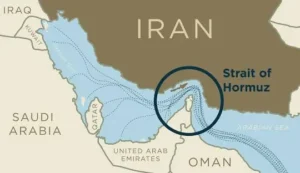
Trump announced a 20% “reimbursement” fee on cargo transiting the Strait of Hormuz and then reversed the plan, citing talks with Gulf leaders and opting for investment deals instead.
What was proposed and why it failed
- Proposal: A 20% levy on cargo value to cover US costs of securing the strait.
- Key flaws: No clear formula for calculation; enforcement mechanisms were unspecified likely violation of customary maritime law on free transit.
International and legal objections
- IMO stance: The International Maritime Organization opposed mandatory tolls on international straits; such charges lack legal basis under accepted norms.
- Policy inconsistency: The US historically defended freedom of navigation and opposed Iran’s toll proposals—Trump’s plan reversed that posture, risking diplomatic backlash.
why India would be hit hard
- Energy exposure: 90% of India’s LPG imports from West Asia transit Hormuz; crude and LNG flows are also heavily routed through the strait. A 20% surcharge would sharply raise landed fuel costs.
- Macro effect: Every $1/barrel rise in oil raises India’s import bill by roughly $2 billion annually; a 20% fee on crude priced at $75/barrel would add billions to the import bill.
Strategic and operational limits
- Control gap: The US cannot unilaterally guarantee safe passage across a strait it does not control; enforcement would require sustained naval presence and allied consent.
- Escalation risk: Charging tolls could legitimise reciprocal fees (e.g., Iran) or provoke further maritime confrontation, disrupting global trade.
Conclusion:
The episode showed that unilateral tolls on international straits are legally fraught, diplomatically costly and economically damaging practical energy security requires diversification and multilateral cooperation.
DRAFT NATIONAL HEALTH RESEARCH POLICY 2026
TOPIC: (GS2) POLITY: THE HINDU
The Department of Health Research released the Draft National Health Research Policy 2026 to update the 2011 framework and invited public feedback. It proposes higher funding, a national research agenda, and new governance to better match research with India’s health needs.
What the draft seeks to do
- Align research with disease burden and publichealth priorities (TB, AMR, NCDs, maternalchild health).
- Boost indigenous innovation and speed translation of findings into policy and practice.
- Reduce fragmentation by creating a unified national agenda and clearer governance.
Major proposals
- Funding increase: Public healthresearch spending to rise from 0.024% of GDP now to 0.072% by 2037 and 0.15% by 2047.
- Threetier governance: A National Stewardship Committee, DHR as nodal agency, and ICMR as scientific lead.
- National Health Research Agenda: Periodic prioritysetting based on burden, equity and preparedness.
- New evaluation metric: Move from publication counts to ICMRIRIS style impact assessment measuring policy and health outcomes.
Enablers and regulatory changes
- Simplified ethics for multicentre trials and a proposed National Research Integrity Office.
- Shared infrastructure: Greater access to labs, biobanks and the IRISE model for resource sharing.
- Responsible AI & data governance norms for health research.
Implementation challenges
- Funding realism: Targets require sustained budgetary commitment and privatesector leverage.
- Capacity gaps: Many medical colleges need research offices, trained staff and ethics committees.
- Translation bottlenecks: Stronger institutional links are needed between researchers, health programmes and state governments.
Conclusion:
The draft is a forwardlooking blueprint to make India’s health research missionoriented and impactdriven success will depend on funding, institutional capacity and strong statecentre coordination.
SULPHUR DIOXIDE POLLUTION FROM COAL PLANTS
TOPIC: (GS3) ENVIRONMENT: THE HINDU
A study found that about 81% of SO₂ emissions from coal plants within 300 km of DelhiNCR come from units exempted from installing pollution controls.
What is Sulphur Dioxide (SO₂)
- Nature: Colourless, pungent gas produced when sulphurbearing fuels burn.
- Primary sources: Coalfired power plants, oil refineries, metal smelters; natural sources include volcanoes.
- Transformation: Oxidises in air to form sulfate aerosols and acid rain; contributes to PM2.5 formation.
Health and environmental impacts
- Human health: Irritates airways, worsens asthma and bronchitis; indirectly raises cardiovascular risk via PM2.5.
- Ecosystems: Causes acid deposition, damages crops, forests and aquatic life; degrades soil fertility.
- Economic cost: Crop losses, healthcare burden and reduced labour productivity in polluted regions.
Why the DelhiNCR finding matters
- Regional transport: SO₂ travels long distances; emissions from distant exempt plants still affect urban airsheds.
- Regulatory loopholes: Exemptions for older or small units undermine national standards and NCAP objectives.
- Equity: Vulnerable populations in cities bear health costs from rural/industrial emissions elsewhere.
Technical and regulatory solutions
- Flue Gas Desulphurisation (FGD): Removes up to 90–95% SO₂; retrofit priority for highemitting units.
- Continuous Emission Monitoring Systems (CEMS): Public, realtime disclosure improves compliance and accountability.
- Phaseout of exemptions: Reassess distancebased or agebased waivers; align with MoEFCC and CPCB norms.
- Energy transition: Accelerate renewables, storage and cleaner fuels to reduce coal dependence (CEA and MNRE targets relevant).
Implementation challenges
- Cost and finance: FGD retrofits are capitalintensive; need viability support and lowcost credit.
- Operational issues: Water availability, ash handling and space constraints at old plants.
- Enforcement: Requires stronger CPCBstate coordination and transparent CEMS data use.
Conclusion:
Closing exemption gaps, mandating FGD/CEMS and accelerating clean energy are essential to cut SO₂, protect health and meet India’s airquality commitments.
SHANTI VISION
TOPIC: (GS2) INTERNATIONAL RELATIONS: THE HINDU
India launched the SHANTI vision Securing Holistic Advancement through Norms, Trust and Integrity as the thematic platform for its 2028–29 campaign for a nonpermanent UN Security Council seat. What is SHANTI
- Acronym meaning: Securing Holistic Advancement through Norms, Trust and Integrity.
- Purpose: Serve as India’s guiding framework at the UN to promote inclusive decisionmaking, predictable norms and cooperative security solutions.
- Context: Launched ahead of India’s 2028–29 UNSC bid to shape the campaign narrative and policy priorities.
Core pillars
- Amplify Global South voices: Advocate for equitable representation and attention to development and financing concerns of developing countries.
- Technologyaware peacekeeping: Push for betterequipped, realistic UN mandates that use technology responsibly (drones, surveillance, data analytics) while protecting rights.
- Counter transnational threats: Strengthen legal cooperation against terrorism, climatedriven displacement and maritime insecurity.
- Responsible tech norms: Promote global rules to prevent misuse of AI, cyber tools and dualuse technologies by state and nonstate actors.
- Development partnerships: Leverage India’s project footprint and capacitybuilding ties to build trust and practical cooperation.
Why SHANTI matters
- Diplomatic: Frames India as a consensus builder for reforming multilateral institutions and for expanding UNSC representation.
- Security: Seeks to modernise peace operations and maritime governance to protect global trade routes.
- Economic & developmental: Links security with development financing and infrastructure cooperation for the Global South.
- Normative: Aims to shape international rules on emerging tech where regulatory gaps exist.
Practical implications and examples
- UN engagement: Use India’s UNSC terms and peacekeeping record (large troop contributions) to argue operational credibility.
- Maritime security: SHANTI’s maritime focus resonates with concerns over chokepoints and freedom of navigation.
- Tech governance: Proposals can feed into UN processes on AI, cyber norms and the Group of Governmental Experts (GGE) on Lethal Autonomous Weapons Systems.
- Development diplomacy: Cite India’s lines of credit and projects across many countries to show delivery capacity.
Policy challenges and considerations
- Coalition building: Winning a UNSC seat requires sustained diplomacy across regional groups and the African, Latin American and AsiaPacific blocs.
- Reform realism: Structural UNSC reform (permanent seat expansion) remains politically difficult; SHANTI must balance ambition with achievable priorities.
- Operationalising tech norms: Translating principles into binding rules will need multilateral consensus and technical capacity building.
Conclusion:
SHANTI positions India as a pragmatic reformer seeking inclusive governance, techsensitive peacekeeping and stronger Global South representation to make the UN more effective and equitable.
UMANG PORTAL
TOPIC: (GS2) POLITY: THE HINDU
Researchers recently disclosed serious security flaws in the UMANG portal, raising concerns about data safety across multiple government services. UMANG is central to Digital India service delivery, so vulnerabilities could affect citizen access and trust in egovernance.
What is UMANG
- Unified platform: Single app and web portal to access services from Central, State and local bodies.
- Objective: Simplify citizen access to government schemes and documents anytime, anywhere.
- Ownership: Developed under MeitY as part of the Digital India programme; official details on the MeitY and UMANG websites.
Key features
- Multichannel access: Mobile app, web portal and partner kiosks; supports 23 Indian languages.
- Wide coverage: Integrates services from 2000+ offerings across 220+ departments (e.g., DigiLocker, EPFO, PAN, utility payments).
- Interoperability: Single signon and Aadhaar/UMANG ID linkages for seamless transactions.
Significance
- Ease of governance: Reduces transaction costs, improves service reach and supports financial inclusion.
- Administrative efficiency: Streamlines delivery, reduces paperwork and enables realtime tracking.
- Digital inclusion: Language support and partner centres help rural and nonsmartphone users.
Security concerns and implications
- Data risk: Vulnerabilities can expose personal and financial data across multiple services.
- Trust deficit: Breaches undermine citizen confidence in egovernance and slow digital adoption.
- Systemic impact: A compromised gateway can disrupt many dependent services simultaneously.
Conclusion:
Fixing UMANG’s security gaps and strengthening monitoring are essential to preserve citizen trust and the integrity of India’s digital public infrastructure.
UNFPA SURVEY
TOPIC: (GS3) ECONOMY: THE HINDU
A recent UNFPA survey shows most young Indians still desire children, but economic pressures and gender inequality are delaying family formation. The finding highlights demographic, social and policy challenges for India’s reproductive and youth agendas.
UNFPA
- UN agency founded in 1967 to support sexual and reproductive health, population data and gender equality.
- Role: Provides technical and financial support for censuses, surveys and programmes; funded by voluntary contributions.
- Headquarters: New York; policy guidance from UNGA and ECOSOC.
Key findings
- Desire persists: Majority of young adults want children but postpone parenthood.
- Drivers of delay: Rising cost of living, job insecurity, housing constraints and unequal gender roles.
- Policy implication: Fertility intentions are shaped by economic opportunity and social norms.
Why it matters
- Demography: Delayed childbearing affects fertility rates, age structure and longterm dependency ratios.
- Gender equality: Persistent care burdens on women reduce labour force participation and career continuity.
- Health systems: Need for youthfriendly reproductive services, contraception access and maternal care planning.
- Economic policy: Housing, employment and social protection influence family decisions.
Links to Indian data and policy
- Census/NFHS: Use Census and NFHS rounds for baseline fertility and health indicators.
- Government schemes: Align findings with Ministry of Health & Family Welfare programmes on family planning and maternal health.
- UNFPA resources: Technical guidance on youth, gender and reproductive health available on UNFPA portals.
Conclusion:
Addressing delayed parenthood requires integrated policies on livelihoods, gender equality and accessible reproductive health services.