

...
Daily Current affairs 13 August 2026

Daily Current Affairs 13-August-2026

Share this Post

URBAN TRAFFIC CONGESTION IN INDIA

TOPIC: (GS3) ECONOMY: THE HINDU

Recent data visualizations reveal that India’s major cities are losing more than half their freeflow traffic speed during peak hours, highlighting the urgent need for reforms in urban mobility and infrastructure.

Speed Decline in Metros

  • Delhi: Speed drops from 46 km/h to 19 km/h; congestion persists throughout the day.
  • Hyderabad & Mumbai: Speeds fall from 40 km/h to 15 km/h; midday recovery in Hyderabad but not in Mumbai.
  • Bengaluru: 38 km/h to 13 km/h, showing sustained congestion with minimal fluctuation.
  • Kolkata: 29 km/h to 10 km/h, among the lowest in Tier1 cities.
  • Tier2 cities also face similar declines, affecting productivity and daily life.

Congestion Patterns

  • Delhi: Continuous congestion with little relief.
  • Hyderabad: Some midday recovery, but peak hours remain problematic.
  • Bengaluru: Consistently congested, reflecting poor road capacity and high vehicle density.
  • Heatmaps show travel time reliability is weak, impacting commuters, logistics, and emergency services.
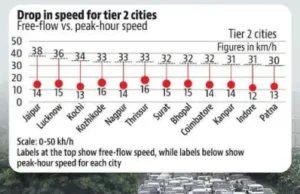
Urban Traffic Congestion in India

Connectivity and Urban Design

  • Network design matters more than road length.
  • Example: A 7.5 km trip covers 65% of Delhi’s area but only 59% in Kolkata.
  • Delhi: Yamuna crossings force longer detours.
  • Bengaluru: Whitefield and Basavanagudi routes increase travel distance due to poor connectivity.
  • WRI India stresses that better urban planning and multimodal integration can reduce detours.

Broader Implications

  • Economic Loss: Billions lost annually due to wasted fuel, delays, and reduced productivity.
  • Environmental Impact: Higher emissions worsen air quality; transport sector contributes ~13% of India’s CO₂ emissions.
  • Public Health: Stress, respiratory illnesses, and reduced quality of life.
  • Urban Planning: Need for metro expansion, bus rapid transit, cycling infrastructure, and smart traffic management.
  • Global Comparison: Singapore and Tokyo manage congestion better through integrated public transport, congestion pricing, and strict vehicle ownership rules.

Challenges

  • Rapid Urbanisation & Vehicle Growth: India’s urban population is 475 million (2025) and projected to add 416 million more by 2050. Cities contribute 63% of GDP, expected to rise to 75% by 2030.
  • Inadequate Public Transport: Metro systems cover only a fraction of urban areas. Bus rapid transit (BRT) projects face delays and poor integration.
  • Poor Road Design & Connectivity: Delhi’s Yamuna crossings force long detours. Bengaluru’s Whitefield suffers from poor connectivity, increasing travel distances. Road networks expand in length but not in efficiency.
  • Environmental & Health Costs: Transport contributes ~13% of India’s CO₂ emissions. Congestion increases particulate matter, worsening respiratory diseases.
  • Weak Traffic Management: Reliance on fixedtiming signals and manual enforcement. Limited realtime data integration compared to global benchmarks.

Way Forward

  • Integrated Public Transport: Expand metro and suburban rail networks. Strengthen bus fleets with GPS tracking and dedicated lanes.
  • Smart Traffic Systems: AIpowered Adaptive Traffic Control reduced waiting time by 33% in Bengaluru. Advanced Traffic Management Systems (ATMS) show 28–48% reduction in travel times and up to 73% fall in accident fatalities.
  • Policy & Governance: Implement congestion pricing (Singapore model). Encourage electric vehicles under FAME scheme to reduce emissions. Align Comprehensive Mobility Plans (CMPs) with city master plans for holistic growth.
  • Financing & PPP Models: PublicPrivate Partnerships for metro, BRT, and ATMS deployment. Explore innovative financing like land value capture and green bonds.

Conclusion

Traffic congestion in India is a multidimensional urban crisis impacting economy, environment, and public health demanding integrated transport planning and sustainable mobility solutions.

E20 ETHANOL BLENDING PUSH

TOPIC: (GS3) ECONOMY: THE HINDU

The government informed Parliament that the ethanol blending programme saved nearly ₹2 lakh crore in foreign exchange, even as Opposition leaders criticised the E20 rollout, citing vehicle damage and consumer concerns.

About Ethanol Blending

  • Ethanol Basics: Biofuel made from sugarcane, molasses, maize, surplus rice, and damaged foodgrains.
  • E20 Definition: Petrol with 20% ethanol and 80% petrol.
  • Policy Goal: Reduce crude imports, save forex, support farmers, and cut emissions.
  • Capacity Expansion: ~500 distilleries, 18–20 billion litres capacity; OMCs contracted 10.5 billion litres for blending.
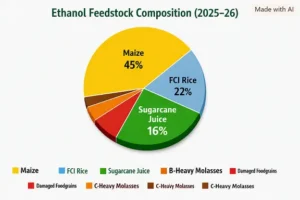
E20 Ethanol Blending Push

Benefits Claimed

  • Foreign Exchange Savings: ₹2 lakh crore saved; 32 million tonnes crude substituted.
  • Farmer Support: Demand for maize and sugarcane boosts rural incomes.
  • Energy Security: Reduces dependence on volatile global oil markets.
  • Environmental Gains: Lower CO₂ emissions, aligns with SDG13 (Climate Action).

Concerns Raised

  • Vehicle Compatibility: Post2023 vehicles are E20ready. Legacy fleet (77%) faces risks: degraded fuel hoses, corrosion, sludge formation. Surveys show mileage losses >10% in older vehicles.
  • Conflicting Assessments: IIT Kanpur lab: <5% efficiency loss. realworld failures in pumps/injectors. Govt: 2–6% mileage penalty acknowledged.
  • Food Security Risks: Diversion of rice and sugarcane could stress stocks during monsoon failure or crop loss.
  • Pace of Transition: India moved from E10 (2022) to E20 (2025) rapidly, unlike Brazil’s gradual decadeslong rollout.
  • Cost Debate: Ethanol procured at ~₹70/litre vs petrol ~₹105/litre, but tax structures make direct comparison complex.

Way forward

  • Gradual Implementation: Adopt a phased rollout of blending targets, ensuring consumer advisories and technical guidance accompany each stage.
  • Technology Support: Provide incentives for retrofitting kits and upgrades to make older vehicles compatible with E20 fuel.
  • Diversified Feedstock: Encourage use of nonfood biomass, crop residues, and secondgeneration (2G) ethanol to reduce pressure on food crops.
  • Consumer Awareness: Launch transparent campaigns explaining mileage impacts, maintenance needs, and longterm benefits to build public confidence.
  • Learning from Global Models: Draw lessons from Brazil’s gradual transition and US flexfuel standards to ensure a smoother, more reliable adoption in India.

Conclusion

India’s E20 push reflects a bold step towards energy security and climate goals, but balancing economic gains with consumer confidence and food security is essential for longterm success.


INDIA’S ECONOMIC OUTLOOK AMID WEST ASIA TENSIONS

TOPIC: (GS3) ECONOMY: THE HINDU

The West Asia conflict has once again exposed India’s dependence on imported energy, raising concerns about inflation, monetary stability, and the need for structural reforms in the economy.

Energy Dependence

  • High Import Reliance: India imports over 85% of its crude oil needs, much of it routed through the Strait of Hormuz, a geopolitically sensitive chokepoint.
  • Inflationary Impact: Rising global crude prices directly push up transport, food, and manufacturing costs, worsening inflation.
  • Current Account Deficit: Higher oil bills widen CAD, weaken the rupee, and strain forex reserves.
  • Shortterm vs Longterm Strategy: India’s next economic phase depends on building shortterm buffers (reserves, subsidies) while deepening longterm reforms (energy diversification, fiscal prudence).
  • Fiscal Stress: Subsidies on fuel and fertilizers rise during oil shocks, impacting government finances.

Impact of West Asia Tensions

  • Energy Security: Disruptions in oil supply chains increase volatility in fuel prices.
  • Inflationary Pressure: Higher crude prices push up transport and food costs.
  • Monetary Policy: RBI faces challenges balancing inflation control with growth.
  • External Vulnerability: CAD widens, rupee weakens, and forex reserves face pressure.

Economic Challenges

  • Import Dependence: India’s energy basket is heavily skewed towards crude oil and LNG.
  • Fiscal Stress: Subsidies on fuel and fertilizer rise during oil shocks.
  • Industrial Impact: Manufacturing costs escalate, affecting competitiveness.
  • Global Linkages: Any disruption in West Asia impacts India’s trade partners and supply chains.

Way Forward

  • Diversification of Energy Sources: Expand renewable energy, nuclear power, and domestic exploration.
  • Strategic Petroleum Reserves (SPR): Strengthen reserves to cushion against supply shocks.
  • Regional Diplomacy: Enhance ties with Gulf nations to secure longterm contracts.
  • Reforms in Logistics & Infrastructure: Reduce dependence on imported fuel by improving railways, electrification, and public transport.
  • Fiscal Prudence: Rationalize subsidies and strengthen fiscal buffers.
  • Green Transition: Align with National Hydrogen Mission and Renewable Energy targets (500 GW by 2030) to reduce fossil fuel reliance.
  • Global Example: Countries like Japan and South Korea maintain strong SPR and diversified energy portfolios to withstand shocks.

Conclusion

India’s economic resilience depends on building buffers against external shocks while accelerating reforms in energy diversification and sustainable growth.

A NEW VOCABULARY OF GENDER JURISPRUDENCE

TOPIC: (GS2) POLITY: THE HINDU

The Allahabad High Court’s 2023 ruling in a POCSO case has sparked debate on how Indian courts interpret gendersensitive issues, highlighting the need for a more empathetic and inclusive legal vocabulary.

Judicial Concerns in Gender Cases

  • Rigid Judicial Language: Courts often use technical terms that fail to capture the lived experiences of survivors of sexual violence.
  • Interpretation of “Minor”: Supreme Court rulings show how definitions directly affect justice delivery in sensitive cases.
  • Historical Insensitivity: Survivors have faced secondary victimisation due to rigid frameworks and patriarchal bias.
  • Constitutional Morality: Articles 14 and 21 demand dignity, equality, and gendersensitive interpretation.
  • International Guidelines: UN stresses empathetic adjudication and survivorcentric approaches.
  • Law Commission Reports: Past recommendations call for reforms in sexual offence trials and survivor protection.

Recent Judicial Developments

  • Progressive High Court Rulings: Several judgments now emphasise survivor dignity, contextual interpretation, and empathetic reasoning.
  • Supreme Court Directions: The apex court has stressed the use of genderneutral language and reinforced protection for minors in sensitive cases.
  • Policy Integration: The National Judicial Academy has introduced structured modules on gender sensitivity for judicial officers.
  • Civil Society Role: NGOs and women’s groups actively push for survivorcentric reforms and awareness campaigns.

Way Forward

  • Judicial Training: Mandatory sensitisation for judges and prosecutors.
  • Inclusive Language: Adopt survivorfriendly terminology in judgments.
  • Legal Reforms: Amend laws to reflect contemporary understanding of gender and consent.
  • Technology Use: Virtual hearings and anonymisation to protect survivor identity.
  • Comparative Example: Countries like Canada and South Africa integrate traumainformed practices in courts.

Conclusion

India’s judiciary must evolve a new vocabulary of gender jurisprudence that is empathetic, survivorcentric, and aligned with constitutional values of dignity and justice.

JUSTICE YASHWANT VARMA CASH ROW

TOPIC: (GS2) POLITY: THE HINDU

A parliamentary inquiry committee has found serious charges proved against former Allahabad High Court judge Yashwant Varma, including possession of unexplained cash and interference with evidence, raising fresh questions on India’s judicial accountability framework.

Case Background

  • In March 2025, burnt and partially destroyed currency notes were discovered at Justice Varma’s official residence in New Delhi.
  • Following this, 146 Lok Sabha MPs moved a removal motion in August 2025.
  • A threemember committee under the Judges (Inquiry) Act, 1968 was constituted, comprising Justice Aravind Kumar (Supreme Court), Chief Justice Shree Chandrashekhar (Bombay HC), and senior advocate B.V. Acharya.

Charges Framed and Findings

  • Unexplained Cash: Large quantities of ₹500 notes found without lawful explanation.
  • Interference with Evidence: Burnt notes disappeared before lawful seizure; staff seen cleaning storeroom after fire.
  • Misleading Conduct: Furnished evasive and misleading explanations, failing the candour expected of a constitutional authority.
  • The committee held all three charges proved.

Accountability Questions Raised

  • Responsibility for Disappearance: Though no direct proof of removal, call records showed Varma in contact with staff during the incident; failure to secure evidence termed “dereliction of duty.”
  • Withdrawal from Inquiry: The panel rejected his claim that resignation ended proceedings, noting charges were already framed, witnesses examined, and defence filed.
  • Resignation Impact: He resigned on April 9, 2026, making impeachment moot since removal applies only to sitting judges.

Constitutional and Legal Dimensions

  • Judicial Resignation Loophole: Past cases (Justice P.D. Dinakaran, Justice Soumitra Sen, 2011) show resignation halts impeachment.
  • Unresolved Question: Can Parliament proceed with removal motion against a judge who has already resigned? Current law suggests not.
  • Need for Reform: Experts call for amending the Judges’ Inquiry Act to prevent resignation from neutralising accountability.
  • Criminal Liability: Though impeachment lapses, resignation removes judicial immunity, enabling criminal prosecution under ordinary law.

How the Case Raises Questions on Democratic Pillars

  • Judiciary’s Integrity: The judiciary is a cornerstone of democracy. Proven misconduct by a High Court judge undermines public trust in courts, raising doubts about impartiality and independence.
  • Parliamentary Oversight: The inability of Parliament to continue impeachment once a judge resigns weakens legislative oversight, exposing loopholes in the Judges’ Inquiry Act, 1968. This dilutes the accountability mechanism designed to check judicial misconduct.
  • Rule of Law: When serious charges are proved but resignation halts proceedings, it creates a perception that constitutional functionaries can escape accountability. This erodes the principle of equality before law, a fundamental democratic value.
  • Institutional Credibility: The case highlights gaps in India’s accountability framework compared to countries like the UK and US, where inquiries continue even after resignation. Such loopholes weaken the credibility of democratic institutions and governance.

Conclusion

The Varma case exposes a critical gap in India’s judicial accountability system — resignation can derail impeachment despite proven charges, underscoring the urgent need to strengthen the Judges’ Inquiry Act.

CONTAINER MANUFACTURING ASSISTANCE SCHEME (CMAS)

TOPIC: (GS3) ECONOMY: THE HINDU

The Union Government has announced a ₹10,000 crore Container Manufacturing Assistance Scheme (CMAS) to boost domestic production of shipping containers and reduce dependence on imports.

About the Scheme

  • Objective: Build a competitive container manufacturing industry in India.
  • Coverage: Supports new Greenfield units and expansion of existing Brownfield facilities.
  • Target: Raise annual domestic capacity to 7.5 lakh TEUs, nearly 10 times current levels.
  • Financial Outlay: ₹10,000 crore spread over five years.

Key Features

  • Capital assistance for new factories.
  • Operational support to improve competitiveness.
  • Testing infrastructure for quality assurance.
  • Skilling and capacity building for workforce development.
  • Integration with national policies like Make in India, PM Gati Shakti, Sagarmala Programme, and Maritime Amrit Kaal Vision 2047.

Significance

  • Logistics Efficiency: Reduces reliance on imported containers, ensuring timely availability for exports.
  • Economic Impact: Strengthens supply chain resilience and supports India’s growing maritime trade.
  • Employment: Creates jobs in manufacturing, testing, and allied services.
  • Strategic Autonomy: Enhances India’s self-reliance in critical logistics infrastructure.
  • Global Context: Countries like China dominate container manufacturing; India’s entry strengthens its position in global shipping.

Conclusion

The CMAS is a strategic step towards logistics selfreliance, aligning industrial growth with India’s maritime vision and global trade ambitions.

PRADHAN MANTRI NATIONAL DIALYSIS PROGRAM (PMNDP)

TOPIC: (GS2) SOCIAL JUSTICE AND HEALTH: THE HINDU

The Union Health Ministry reported that PMNDP is now active in all 36 States/UTs, covering 751 districts with 1,856 dialysis centres and 13,535 haemodialysis machines.

About the Program

  • Launch: Introduced in 2016 under the National Health Mission (NHM).
  • Objective: Provide affordable and accessible dialysis services at district hospitals.
  • Beneficiaries:
    • BPL patients: Free dialysis.
    • NonBPL patients: Subsidised services close to community.
  • Expansion: Centres scaled down to Community Health Centres (CHCs) in tribal/remote areas.
  • Components:
    • Hemodialysis (HD): Blood filtered through machine (3 sessions/week).
    • Peritoneal Dialysis (PD): Abdomen lining acts as filter; feasible for homebased care.

Implementation

  • Modes of Service Delivery:
    • PPP mode: 14 States/UTs.
    • Inhouse mode: 16 States/UTs.
    • Hybrid mode: 6 States/UTs.
  • PPP Guidelines: Private partner provides machines, RO water plant, consumables, and staff; State provides space, power, and water.
  • Digital Integration: PMNDP portal (2022) launched to build a renal registry and enable One Nation–One Dialysis portability.
  • Funding: Supported by NHM financial assistance.
  • Nodal Ministry: Ministry of Health and Family Welfare.

Significance

  • Equity in Healthcare: Ensures access to kidney care across geography.
  • Financial Protection: Reduces outofpocket expenditure for chronic patients.
  • Public Health Impact: Addresses rising burden of chronic kidney disease in India.
  • Digital Governance: Registry improves monitoring and policy planning.

Conclusion

PMNDP is a landmark initiative ensuring equitable kidney care, combining affordability, accessibility, and digital integration under NHM.

NAVYA PROGRAMME

TOPIC: (GS3) ECONOMY: THE HINDU

The Minister of State for Skill Development & Entrepreneurship recently informed the Lok Sabha about the NAVYA Programme, launched in 2025 to train adolescent girls in aspirational districts.

About the Programme

  • Definition: NAVYA stands for Nurturing Aspirations through Vocational training for Young Adolescent Girls.
  • Launch: Initiated in 2025 under Pradhan Mantri Kaushal Vikas Yojana 4.0 (PMKVY 4.0).
  • Joint Initiative: Ministry of Skill Development & Entrepreneurship (MSDE) + Ministry of Women & Child Development.
  • Target Group: Adolescent girls aged 16–18 years in aspirational districts.
  • Objective: Equip girls with industryrelevant skills for socioeconomic independence.

Key Features

  • Skill Training: Industryaligned courses with OntheJob Training (OJT).
  • Futuristic Roles: Focus on emerging job sectors (digital economy, green jobs, entrepreneurship).
  • Holistic Development Module:
    • Digital literacy
    • Financial literacy
    • Career readiness
    • Entrepreneurship orientation
  • Monitoring Framework:
    • Realtime tracking via Skill India Digital Hub (SIDH).
    • Regular reviews with Project Implementing Agencies (PIAs) and State Skill Development Missions (SSDMs).

Significance

  • Gender Empowerment: Strengthens participation of young women in workforce.
  • Social Equity: Targets aspirational districts, bridging ruralurban skill gaps.
  • Economic Impact: Builds a skilled female workforce contributing to GDP.
  • Alignment with National Goals: Supports Skill India Mission, Digital India, and Viksit Bharat 2047.
  • Comparative Example: Similar to Kanyashree Scheme (West Bengal) and Beti Bachao Beti Padhao, but NAVYA focuses on vocational skills.

Conclusion

The NAVYA Programme is a forwardlooking initiative that combines skill training with holistic empowerment, ensuring adolescent girls become active contributors to India’s socioeconomic transformation.

Write a Review

Your email address will not be published. Required fields are marked *

Seraphinite AcceleratorOptimized by Seraphinite Accelerator
Turns on site high speed to be attractive for people and search engines.