

Table of Contents
ToggleVANASHAKTI VERDICT AND ENVIRONMENTAL VIOLATIONS
TOPIC: (GS3) ENVIRONMENT: THE HINDU
On July 29, 2026, the Supreme Court of India delivered its judgment in Vanashakti vs Union of India, clarifying that prior Environmental Clearance (EC) is mandatory and cannot be bypassed through administrative mechanisms.
Key Highlights of the Judgment
- Mandatory Prior EC: The Court reaffirmed that projects must obtain EC before starting operations under the EIA Notification, 2006.
- Invalidation of Past Mechanisms: The 2017 Notification and 2021 Office Memorandum allowing post‑facto approvals were struck down for fresh cases.
- Statutory Power Retained: Section 3 of the Environment Protection Act, 1986 empowers the government to frame a fresh statutory scheme if required in public interest.
- Administrative vs Statutory Distinction: Office memoranda cannot override law, but statutory notifications remain permissible if backed by legislation.
- Balanced Approach: The Court acknowledged practical realities—many projects remain in violation—but insisted that any future scheme must be one‑time, transparent, and environmentally robust.
Wider Policy Impact
- Industrial & Infrastructure Projects: Thousands of units across real estate, mining, and public utilities face uncertainty due to past violations.
- Regulatory Clarity: The verdict closes the door on routine post‑facto approvals but leaves scope for a lawful one‑time framework.
- Public Interest Safeguards: Any future scheme must include damage assessment, remediation, compensation, and strict compliance checks.
Challenges
- Frequent Violations: CAG (2025) reported that over 35% of projects in India began without prior EC, reflecting weak enforcement.
- Institutional Capacity: MoEFCC has limited manpower—only ~200 officers nationwide to monitor thousands of projects.
- Investor Pressure: Industry bodies argue that closure of projects worth ₹50,000 crore could harm employment and growth.
- Public Trust: Communities often feel excluded from decision‑making; NITI Aayog notes low participation in Gram Sabha consultations during EIAs.
Way Forward
- Strengthen Enforcement: Adopt digital monitoring tools (satellite imagery, AI compliance checks).
- One‑Time Statutory Window: Government may design a limited scheme with strict safeguards, similar to EU’s Environmental Liability Directive.
- Capacity Building: Expand MoEFCC manpower; train state pollution boards.
- Community Participation: Strengthen Gram Sabha role in EIAs; ensure transparency through public disclosure portals.
- Diversified Development: Balance industrial growth with ecological sustainability; integrate SDG‑13 (Climate Action) into national planning.
Conclusion
The Vanashakti verdict ensures that environmental law remains strict yet pragmatic, mandating prior EC while allowing space for a lawful, one‑time solution to legacy violations.
FREE PUBLIC COACHING AND PRIVATE COACHING INDUSTRY
TOPIC: (GS2) POLITY: THE HINDU
On Independence Day 2026, Prime Minister Narendra Modi announced free online coaching for competitive exams through India’s digital public infrastructure, aiming to reduce dependence on costly private coaching and address inequities exposed by the NEET paper leak protests.
Background
- Digital Push: India already has platforms like SWAYAM and DIKSHA, but they remain underutilised.
- Coaching Dependency: Families spend ₹58,000 crore annually on coaching (NITI Aayog, 2024).
- Exam Pressure: Competitive exams like NEET, JEE, UPSC demand skills beyond school curricula, driving students to coaching hubs.
Dimensions of the Debate
- Equity in Education: Free coaching can reduce income‑based disparities, especially for rural and poor students.
- Technology Gap: Gen‑Z expects AI‑driven, mobile‑first, personalised learning; current platforms lack immersive features.
- School vs Exam Curriculum: Schools focus on conceptual learning, while competitive exams demand time‑bound problem solving and elimination strategies.
- Hybrid Model Need: Online lectures alone cannot replace peer competition, mentoring, and doubt‑solving forums offered by coaching centres.
Challenges
- Digital Divide: TRAI (2025) reports ~45 crore Indians lack reliable internet access, especially in rural areas.
- Quality Assurance: Without structured assessments and mentoring, free coaching risks becoming a video library.
- Curriculum Gap: NCERT notes mismatch between school syllabi and competitive exam requirements.
- Economic Impact: Coaching industry employs lakhs; sudden disruption may affect livelihoods.
Way Forward
- AI‑Enabled Learning: Develop adaptive platforms with personalised feedback, digital twins, and immersive content.
- Skill Hubs: NEP 2020 recommends school‑based skill hubs combining physical mentoring with online modules.
- Satellite Connectivity: Use LEO satellite tech to bridge last‑mile gaps in remote areas.
- Structured Pedagogy: Weekly tests, doubt forums, and peer interaction must be integrated into public platforms.
- Exam‑Specific Platforms: Instead of one common stack, create dedicated modules per exam to maintain quality.
Conclusion
Free public coaching can democratise exam preparation, but only if it evolves into a structured, AI‑enabled, hybrid model that matches the rigor of private coaching while ensuring inclusivity.
GAGANYAAN MISSION AND THERMAL PROTECTION SYSTEM
TOPIC: (GS3) SCIENCE AND TECHNOLOGY: THE HINDU
India’s Gaganyaan crew module will face extreme heat during re‑entry, with ISRO confirming that its ablative thermal protection system (TPS) will safeguard astronauts by keeping internal temperatures below 150°C despite external heating of up to 1,800°C.
Why Re‑entry is Challenging
- High Velocity: Capsule re‑enters at 7,500–8,000 m/s, converting kinetic energy into heat.
- Extreme Temperatures: Outer surface faces ~1,800°C, risking structural failure.
- No Abort Option: Once descent begins, crew cannot intervene; systems must be fully reliable.
- Rapid Deceleration: Constantly changing forces make manual correction impossible.
How the Thermal Protection System Works
- Ablative Shield:
- Absorbs heat and decomposes into char + vapours, carrying heat away.
- Creates a cooler boundary layer to block heat transfer.
- Thickness: 30–35 mm, keeps module interior below 150°C.
- Materials: Carbon phenolic and silica phenolic used; similar to SpaceX Crew Dragon’s PICA shield.
- ISRO Heritage: Demonstrated in SRE (2007) and CARE (2014) missions.
- Other TPS Types:
- Radiative: Re‑emits absorbed heat as infrared radiation (used in reusable vehicles).
- Heat Sink: Absorbs heat without phase change (e.g., copper/aluminium).
Challenges
- Material Testing: DRDO reports that ablative materials must withstand >1,800°C without structural cracks.
- Reliability: NASA data shows ~20% of spacecraft failures occur during re‑entry phase.
- Single‑Use Limitation: Ablative shields cannot be reused, increasing mission costs.
- Integration: Ensuring TPS bonds with module structure under high stress is critical.
Way Forward
- Advanced Materials: Invest in lightweight composites; ISRO exploring ceramic matrix composites.
- Reusable TPS: Long‑term goal to develop radiative/reusable shields for cost efficiency.
- Simulation & Testing: Expand hypersonic wind tunnel facilities; NITI Aayog (2025) recommended more test centres for aerospace.
- International Collaboration: Learn from NASA, ESA, and JAXA on reusable TPS technologies.
Conclusion
The ablative heat shield is ISRO’s proven choice to ensure astronaut safety, combining simplicity and robustness to withstand the fiery re‑entry of Gaganyaan.
WHEAT SUPPLY CRUNCH AMID BLACK SEA ATTACKS
TOPIC: (GS2) INTERNATIONAL RELATIONS: THE HINDU
Recent attacks on Black Sea grain infrastructure have disrupted wheat shipments, pushing global prices up by 17% since July 2026 and raising food security concerns for major importers like Egypt and Indonesia.
Background
- Black Sea Region: Russia and Ukraine together account for nearly 30% of global wheat exports (FAO, 2025).
- Global Dependence: Egypt imports 82% of its wheat from Russia and Ukraine; Indonesia contracted 600,000 tonnes for July–September 2026.
- Price Surge: Benchmark Chicago wheat futures rose 17% in July 2026, reflecting supply disruptions.
Challenges
- Supply Disruptions: Attacks on ports and vessels forced cancellation/delay of dozens of cargoes.
- Food Security Risks: Egypt’s private sector, importing over half its wheat, faces shortages with limited inventories.
- Price Volatility: Jordan cancelled tenders due to high prices; Tunisia warned suppliers against force majeure.
- Shipping Risks: Few shipowners willing to call at Russian/Ukrainian ports; attacks like on Xin Hai Tong 66 highlight dangers.
- Regional Dependence: Asian buyers booked 2–2.5 million tonnes of Black Sea wheat for July–September, now at risk.
Way Forward
- Diversify Sources: Importers turning to Australia, Argentina, U.S., Romania, Bulgaria to replace disrupted cargoes.
- Boost Domestic Production: Egypt procured record volumes of local wheat; Morocco and Tunisia benefited from better rains.
- Strategic Reserves: FAO recommends building buffer stocks; India maintains ~20 million tonnes of wheat reserves under FCI.
- Regional Cooperation: ASEAN and African Union can coordinate grain procurement to reduce vulnerability.
- Technology & Logistics: Satellite monitoring and insurance-backed shipping corridors could reduce risks.
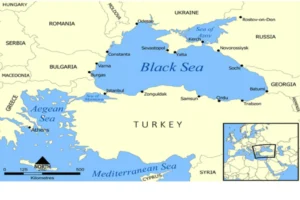
Inland sea bordered by Russia, Ukraine, Georgia, Turkey, Bulgaria, and Romania.
- Connection: Linked to the Mediterranean Sea via the Bosporus Strait, Sea of Marmara, and Dardanelles; connects to the Azov Sea through the Kerch Strait.
- Strategic Importance:
- Major hub for grain exports (Russia & Ukraine together supply ~30% of global wheat).
- Key route for oil and natural gas pipelines.
- Central to NATO–Russia geopolitical tensions.
- Physical Features:
- Area: ~436,000 sq km.
- Depth: ~2,212 m at its deepest point.
- Unique ecology: lower layers lack oxygen, making them biologically inactive.
- Economic Role:
- Important for shipping and trade in Eastern Europe.
- Fisheries and tourism along coasts of Turkey, Bulgaria, and Romania.
- Recent Issues:
- Ongoing Russia–Ukraine conflict disrupted grain terminals and shipping routes.
- Attacks on vessels have raised global food security concerns.
Benchmark wheat futures rose 17% in July 2026 due to supply crunch.
Conclusion
The Black Sea crisis shows that over‑dependence on few suppliers endangers global food security, making diversification and resilient supply chains essential.
INDIA’S ARCTIC NARRATIVE AND GEOPOLITICAL IMPERATIVES
TOPIC: (GS2) INTERNATIONAL RELATIONS: THE HINDU
A Parliamentary Standing Committee on External Affairs report has flagged gaps between India’s Arctic Policy (2022) and its actual capabilities, stressing the need for a clear Arctic strategy to address climate security and geopolitical challenges.
India’s Arctic Historic Link:
- India was among the original 14 signatories of the 1920 Svalbard Treaty.
- Treaty grants Indians visa‑free access to the Svalbard archipelago and rights for commercial activities.
Scientific Presence:
- India operates the Himadri research station at Ny‑Ålesund, Svalbard (since 2008).
- One of only two developing nations with a permanent Arctic research base.
- Research focuses on glaciology, atmospheric sciences, microbiology, and climate change.
Focus Area:
- Engagement largely limited to scientific research.
- Policy intent (Arctic Policy 2022) highlights climate linkages, but capability gaps
- India yet to expand into geopolitical, energy, and shipping dimensions despite growing global competition.
Climate Security Dimensions
- Monsoon Linkage: Studies show Arctic warming influences South Asian monsoon circulation, critical for agriculture (18% of GDP, supports half the population).
- Sea-Level Rise: Melting ice contributes to global rise; 250 million people in South Asian coastal regions at risk by mid‑century (IPCC, 2023).
- Migration & Security: Rising seas could trigger displacement, humanitarian crises, and national security challenges.
Geopolitical Stakes
- Strategic Partners: US and Russia are Arctic powers; China invests heavily despite being non‑Arctic.
- Great Power Competition: Region emerging as hub for energy security, shipping routes, and critical minerals.
- Diplomatic Advantage: India enjoys goodwill with all eight Arctic states; strengthened ties via India‑Nordic Summit and Canada relations.
Challenges
- No Polar Envoy: Arctic affairs split across four MEA divisions; unlike Arctic states and even Singapore, India lacks a dedicated envoy.
- Research Vessel Gap: Polar Research Vessel sanctioned in 2014 still undelivered; limits India’s reach beyond Svalbard.
- Funding Deficit: Only ₹17.53 crore spent in 2024‑25 on Arctic activities — less than 10% of Antarctic spending (MoEFCC data).
- Capability Lag: China operates multiple polar vessels including nuclear icebreakers; India dependent on foreign collaboration.
Way Forward
- Dedicated Polar Ambassador: Ensure coherent policy coordination across ministries.
- Polar Research Vessel: Expedite delivery; emulate China’s interim acquisition model.
- Enhanced Funding: Allocate resources proportionate to climate and strategic importance; prioritise coastal security.
- Integrated Climate Research: Expand studies on Arctic‑monsoon linkages; strengthen collaboration with IPCC and Nordic institutes.
- Strategic Diplomacy: Leverage goodwill with Arctic states to secure access to shipping corridors and mineral supply chains.
Conclusion
India’s Arctic presence must evolve from scientific engagement to strategic capability, aligning climate security with geopolitical interests through stronger institutions, funding, and diplomacy.
CASTE CENSUS 2026 AND DATA CHALLENGES
TOPIC: (GS2) POLITY: THE HINDU
The Registrar General of India has opted for an open-ended caste question in the ongoing Census 2026, raising concerns that the exercise may generate unmanageable and fragmented data similar to the 2011 SECC experience.
What is Census?
- Census is the official process of collecting, compiling, and publishing demographic, social, and economic data of a country’s population.
- Conducted every 10 years in India, it provides vital statistics for planning, governance, and policy formulation.
Historical Background of Caste Enumeration
- 1931 Census: The last comprehensive caste enumeration in India, recording 4,147 distinct castes across provinces. It highlighted the complexity of caste identities and their regional variations.
- 1941 Census: Though caste details were collected, they were excluded from final tabulation due to wartime financial constraints. The Census Commissioner argued that limited resources did not justify detailed caste data collection.
- Post‑Independence: The 1951 Census under Nehru deliberately excluded caste enumeration. This was shaped by ideals of equality and secularism, focusing instead on national integration.
- SC/ST Lists: Presently, the government officially recognises 1,208 Scheduled Castes (SCs) and 730 Scheduled Tribes (STs) across states. These lists form the basis for reservation policies and welfare programmes.
Current Approach – Open-Ended Enumeration
- Respondents state caste in their own words; enumerators record as given.
- Multiple Names: Rajput, Thakur, Singh, Kshatriya may overlap; surnames like Verma vary across regions.
- Risk of Duplication: Misspellings or regional variations create separate entries.
- Assertion of Identities: Similar to 1931 Aad Dharmis in Punjab, new identities may emerge.
Challenges
- Data Explosion: SECC 2011 produced 46.7 lakh caste names, rendering data unusable.
- Regional Variations: Same caste known differently across states; e.g., Yadav consolidation vs Kushwaha fragmentation in Bihar survey.
- Political Sensitivity: Choices in categorisation affect reservation and representation debates.
- Administrative Burden: Without a list, enumerators face difficulty in standardisation.
Way Forward
- Predetermined Lists: Experts like S.K. Thorat recommend exhaustive caste lists, including general category, to minimise errors (2–3% margin).
- Separate Questionnaires: Tailored forms for SCs (untouchability) and STs (geographical isolation) to capture unique exclusions.
- Sub-Categorisation: Capture intra-group hierarchies; NITI Aayog (2025) highlighted uneven benefits within SC/ST reservations.
- Digital Standardisation: Use AI-based text recognition to merge duplicate entries and ensure consistency.
- Transparency: Public consultation on caste lists to avoid political bias, as seen in Bihar survey criticisms.
Conclusion
Open-ended caste enumeration risks fragmented and unusable datasets; a structured, transparent, and standardised approach is essential to make the 2026 caste census meaningful for policy.
NATIONAL MEDICAL COMMISSION AND ROLE
TOPIC: (GS2) POLITY: THE HINDU
The National Medical Commission (NMC) has proposed a Unique Identification (UID) system for doctors, enabling them to practice nationwide without separate state registrations or licenses.
About NMC
- Constitution: Established under the NMC Act, 2019, replacing the Medical Council of India (MCI).
- Headquarters: Located in New Delhi.
- Role: Apex regulator for medical education, institutions, and professionals.
- Composition: 33 members including Chairperson, ex-officio, and part-time members; supported by Medical Advisory Council.
- Autonomous Boards:
- Under-Graduate Medical Education Board
- Post-Graduate Medical Education Board
- Medical Assessment and Rating Board
- Ethics and Medical Registration Board
Functions of NMC
- Policy & Regulation: Maintain standards in medical education and practice.
- Institutional Oversight: Accreditation of medical colleges and recognition of qualifications.
- Healthcare Needs Assessment: Plan for human resources and infrastructure.
- Ethics & Registration: Ensure professional ethics and maintain national registry of doctors.
- Fee Regulation: Frame fee guidelines for 50% seats in private medical colleges.
- Appellate Jurisdiction: Review decisions of autonomous boards.
Challenges
- Fragmented Registrations: State-wise licensing creates duplication and restricts mobility.
- Human Resource Shortage: WHO recommends 1:1000 doctor-patient ratio; India currently at 1:1511 (MoHFW, 2025).
- Infrastructure Gaps: Rural areas face shortage of qualified doctors; NITI Aayog notes 65% of doctors concentrated in urban centres.
- Regulatory Burden: Multiple boards and councils sometimes overlap, slowing decision-making.
Way Forward
- UID Implementation: A national registry will streamline licensing, reduce duplication, and improve mobility.
- Digital Integration: Link UID with Ayushman Bharat Digital Mission for seamless healthcare records.
- Capacity Expansion: Increase medical seats; government aims to add 157 new medical colleges by 2030.
- Ethics & Accountability: Strengthen monitoring of malpractice through centralised reporting.
- Balanced Funding: Increase budget allocation; India spends ~2.1% of GDP on health (Economic Survey 2025), below global average of 6%.
Conclusion
The UID proposal can transform medical regulation by ensuring mobility, transparency, and accountability, aligning India’s healthcare system with global standards.
INDIA ROAD ACCIDENT FATALITIES
TOPIC: (GS2) GOVERNANCE: THE HINDU
Recently, India’s road accident fatalities came into news as official figures for 2024 showed discrepancies between reports released by the Ministry of Road Transport and Highways (MoRTH) and the National Crime Records Bureau (NCRB), raising concerns over data consistency and reliability for policy planning.
Sources of Road Accident Data
- Police records: Primary source, as police are first responders.
- MoRTH data collection: Through its Transport Research Wing (TRW), using formats under the UNESCAP Asia-Pacific project.
- Information gathered: Accident identification, road conditions, vehicles, driver details.
- Shift to eDAR/iRAD: Designed for real-time reporting, but state-level delays persist.
- NCRB data: Compiled via State Crime Record Bureaus (SCRBs), District Crime Record Bureaus (DCRBs), and local police stations.
Legal Basis of Road Accident Data Recording
- Section 106 of Bharatiya Nyaya Sanhita: Fatal road accidents caused by negligence are registered under this section (earlier covered under IPC Section 304-A).
- WHO Global Practice: Nearly half of the countries worldwide rely primarily on police data for accident reporting.
Reasons for Discrepancies
- Different reporting channels: NCRB (Home Ministry) vs MoRTH (coordination with States).
- Mandatory reporting bias: Police must report to NCRB, but MoRTH depends on state cooperation.
- Data limitations: TRW formats restrict details, leading to gaps.
- Under-reporting risks: Victims dying after 30 days often not updated.
- Subjective bias: Police judgments may affect accuracy.
- Persistent challenges: Despite eDAR/iRAD, states report inconsistently.
India’s Global Position
- India has the highest total fatalities worldwide, followed by China and the USA.
- Countries like Iran report higher per capita death rates.
- Several developing nations (Pakistan, Nigeria, Ethiopia, China) show lower per capita fatality rates compared to India.
Measures to Improve Data Accuracy
- Unified Reporting System: Establish a single national platform integrating police, transport, and health departments to ensure consistency.
- Real-time Digital Tools: Strengthen use of e-DAR/iRAD systems with mandatory updates from all states to reduce delays and mismatches.
- Standardized Formats: Adopt uniform templates across ministries and states for accident reporting to avoid variation in categories and definitions.
- Health Department Integration: Include hospital and emergency care data to capture fatalities occurring after the accident, reducing under-reporting.
Conclusion
Reliable statistics are essential for effective policy design, infrastructure planning, and enforcement strategies. Strengthening real-time reporting systems, harmonising data channels, and reducing under-reporting are critical to addressing India’s road safety crisis.