
Table of Contents
ToggleBeyond Political Reshuffles, Renew Education in India
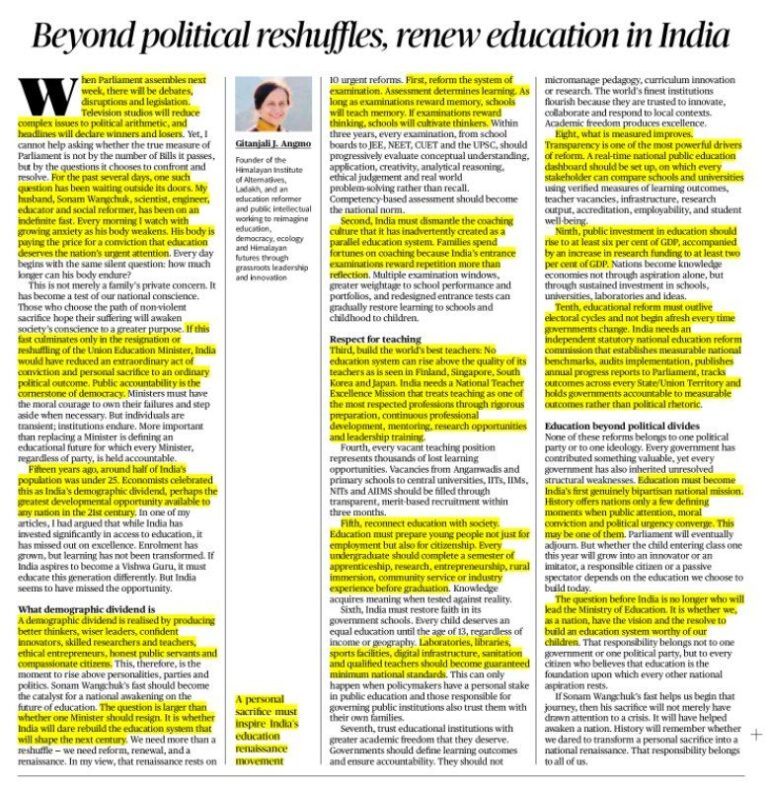
The article argues that India’s education crisis cannot be solved merely through political reshuffles or ministerial changes. The real challenge lies in rebuilding the education system itself so that it prepares young Indians for citizenship, employment, innovation and national development.
Why Education Reform Matters
Demographic Dividend at Risk
India has one of the world’s largest youth populations. This can become a demographic dividend only if young people receive quality education, critical thinking skills and employability. If the education system continues to focus on rote learning and coaching-driven success, India may lose a historic opportunity.
Key Problems in Indian Education
Examination-Centric Learning
The article highlights that India’s education system rewards memorisation more than understanding. From school exams to competitive tests, students are pushed into coaching systems instead of being encouraged to develop creativity, reasoning and problem-solving.
Coaching Culture
The dominance of coaching centres reflects the failure of mainstream schooling. Instead of improving classroom teaching, many families are forced to depend on expensive private coaching, deepening inequality.
Poor Teacher Quality and Vacancies
Teacher shortages, weak training and limited professional development affect learning outcomes. The article stresses that teachers must be treated as the foundation of education reform.
Reform Priorities
Improve Teaching and Assessment
India must shift from rote-based assessment to competency-based learning. Exams should test understanding, creativity, analytical reasoning and real-world application.
Public Investment in Education
The article calls for higher public spending on education, better infrastructure, libraries, laboratories and digital access. Public education must be strengthened so that quality learning does not depend only on private affordability.
Link Education with Society
Education should not only produce employees but responsible citizens. Students must learn constitutional values, empathy, cooperation, environmental awareness and social responsibility.
Conclusion
India’s education crisis needs a national renaissance, not merely political change. Real reform requires better teachers, transparent institutions, public investment, accountable governance and a shift from rote learning to meaningful education. For UPSC aspirants, this topic is important under education policy, governance, demographic dividend, social justice, human capital and inclusive development.
Vocabulary Boost
Demographic Dividend → Economic gains from a large working-age population.
Institutional Autonomy → Freedom for institutions to function independently.
Experiential Learning → Learning through practical, real-world experiences.
Accountability → Responsibility for measurable outcomes.
Educational Renaissance → Comprehensive revival of the education system.
Frequently Asked Questions (FAQs)
What is the article mainly about?
The article argues that India needs deep education reform, not just political reshuffles or changes in education ministers.
Why is education reform important for India?
Education reform is important because India’s demographic dividend can succeed only if young people get quality learning, skills and employability.
What is the problem with India’s exam system?
India’s exam system often rewards memorisation and coaching-based preparation instead of creativity, reasoning and real understanding.
Why are teachers central to education reform?
Teachers are central because better training, motivation, professional development and filling vacancies can directly improve learning outcomes.
Why is this topic important for UPSC?
It is important for UPSC under education policy, governance, demographic dividend, social justice, human capital and inclusive development.
Source From : The Hindu
No One Did It, It Happens: War to Exam Scandals, Pollution to Crumbling Cities
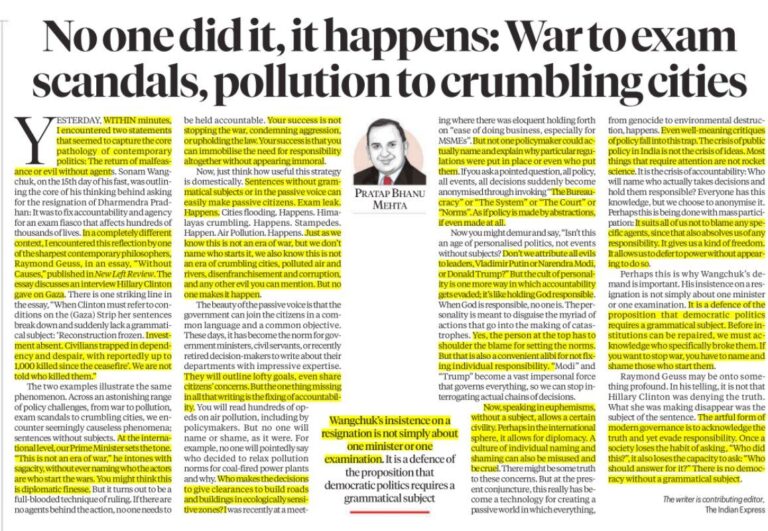
The article argues that modern governance increasingly uses a language of passive responsibility. From wars and exam scandals to pollution, floods and collapsing infrastructure, failures are often presented as events that simply “happen,” without clearly identifying who caused them, who failed to prevent them and who must be held accountable.
The Problem of Accountability
When No One Is Named
The article highlights how public discourse often avoids naming responsible actors. Sentences such as “mistakes were made,” “pollution happened,” or “cities flooded” remove agency from governance failures.
This grammar of evasion allows governments, institutions and decision-makers to escape responsibility. When no one is clearly named, no one is answerable.
Passive Voice in Politics
Avoiding Responsibility
The article explains that passive language has political consequences. It turns avoidable failures into natural events. War becomes something that “happens,” exam scandals “occur,” pollution “rises,” and infrastructure “collapses,” as if no decisions, negligence or policy failures were involved.
Such language weakens democratic accountability because citizens are denied clarity about who made the choices that caused harm.
Examples of Governance Failure
From War to Environment
The article connects different crises: war, environmental destruction, exam irregularities, air pollution, crumbling cities and policy failures. In each case, the key issue is not merely the crisis itself but the refusal to assign responsibility.
Whether it is poor regulation, weak urban planning, institutional failure or political misjudgment, democracy requires identifying the chain of accountability.
Why Naming Matters
Democracy Needs a Subject
The article stresses that democratic politics needs a “grammatical subject.” Citizens must know who acted, who failed, who benefited and who must answer. Without this, public anger becomes directionless and reform becomes impossible.
Naming responsibility is not about blame alone; it is about learning, correction and justice.
Conclusion
The article warns that when governance failures are described as things that merely “happen,” democracy loses its power to demand answers. Accountability requires clear language, named responsibility and institutional courage. For UPSC aspirants, this topic is important under governance, ethics, public accountability, administrative responsibility, democracy, urban governance and institutional reforms.
Vocabulary Boost
Accountability → Obligation to answer for decisions and actions.
Answerability → Duty to justify one’s conduct to the public.
Institutional Failure → Failure of institutions to perform their intended functions.
Diffusion of Responsibility → Responsibility becoming unclear because it is spread across many actors.
Rule of Law → Governance where everyone is subject to the law equally.
Frequently Asked Questions (FAQs)
What is the article mainly about?
The article discusses how political and institutional failures are often presented as events that simply “happen,” avoiding clear responsibility.
What does “passive responsibility” mean?
Passive responsibility means describing failures without naming who caused them, who failed to act or who must be held accountable.
Why is accountability important in democracy?
Accountability ensures that governments, institutions and officials answer for their decisions, mistakes and negligence.
How does language affect governance?
Language can hide or reveal responsibility. Passive language can make avoidable failures look like natural or unavoidable events.
Why is this topic important for UPSC?
It is important under governance, ethics, public accountability, administrative responsibility, democracy and institutional reforms.