

Table of Contents
ToggleSUPREME COURT RULING ON CITIZENSHIP AND ELECTORAL ROLL DELETION
TOPIC: (GS2) POLITY: THE HINDU
The Supreme Court of India clarified that deletion of a person’s name from the electoral roll during Special Intensive Revision (SIR) does not mean automatic loss of citizenship.
Background of the Issue
- Case Context: A threejudge bench led by CJI D.Y. Chandrachud ruled that electoral roll changes are administrative, not determinative of nationality.
- Election Commission Role: Booth Level Officers (BLOs) conduct SIR to verify voter eligibility, but this does not affect citizenship rights.
- Trust Deficit: Concerns arose that name deletion could wrongly be equated with loss of nationality, especially in sensitive states.
- The Court emphasized that only competent authorities can determine citizenship status, not the electoral process.
Key Points from the Judgment
- Citizenship vs Electoral Roll: Electoral rolls are for voting rights; citizenship is a broader legal status.
- Continuity of Rights: Even if a name is deleted, the person remains a citizen until formally declared otherwise.
- Authority: Citizenship determination lies with the Union Government under the Citizenship Act, 1955, not the Election Commission.
Difference Between Citizenship and Residency
- Citizenship: Legal membership of a sovereign state. grants rights like voting, holding public office, and protection under law.
- Residency: Place of living; a resident may or may not be a citizen. Example: Foreign nationals residing in India are residents but not citizens.
Documents Proving Citizenship (as per SIR and Citizenship Act, 1955)
- Birth Certificate: Proof of birth in India before cutoff dates under law.
- Passport: Official document issued by Government of India.
- Aadhaar & Voter ID: Used for identity verification, but not conclusive proof of citizenship.
- Citizenship Certificate: Issued by Ministry of Home Affairs for naturalised or registered citizens.
SPECIAL INTENSIVE REVISION (SIR)
- SIR is a process conducted by the Election Commission of India (ECI) to thoroughly update and verify the electoral rolls in a constituency.
- Purpose: It ensures that only eligible citizens are included as voters, removing duplicate, shifted, or deceased entries.
- Process: Carried out by Booth Level Officers (BLOs) who assist residents in filling forms, checking documents, and verifying identity before finalizing the voter list.
Conclusion:
The Supreme Court ruling reinforces that citizenship is a constitutional and statutory identity, not dependent on electoral rolls, ensuring protection of individual rights against administrative errors.
NITI AAYOG CONSULTS TECH FIRMS ON CONTENT BLOCKING FRAMEWORK
TOPIC: (GS2) POLITY: THE HINDU
The NITI Aayog has initiated consultations with major technology companies on India’s content blocking regime. to make takedown processes more transparent.
Background
- Current Framework: Content blocking in India is governed by the Information Technology Act, 2000 and related rules.
- Volume of Requests: Over 24,000 takedown requests in 2024, projected to cross 25,000 in 2025, highlighting the scale of regulation.
- Stakeholders: NITI Aayog has reached out to CII, IAMAI, BIF, and platforms like Facebook, Instagram, YouTube for feedback.
Who Has the Authority to Block Content
- Section 69A IT Act: Empowers the Central Government to direct blocking of public access to any information on grounds such as sovereignty, national security, public order, or preventing incitement to offences.
- Blocking Rules 2009: Provide procedure and safeguards — including review committees and written orders.
- Supreme Court Clarification: In 2026, the Court reaffirmed that Magistrates and lower courts cannot order blocking; only the Central Government has this authority.
- Scale of Use: MeitY issued ~24,300 blocking orders in 2025, up from ~6,000 annually in 2018–2023, showing rapid expansion.
Impact on Freedom of Speech
- Constitutional Basis: Article 19(1)(a) guarantees free speech; restrictions are allowed only under Article 19(2) (security, public order, decency, etc.).
- Judicial Safeguards: In Shreya Singhal v. Union of India (2015), the Supreme Court upheld Section 69A but stressed procedural safeguards like transparency and review.
- Opacity Concerns: Blocking orders are often secret, with no public disclosure of reasons or affected URLs, undermining accountability.
- Expansion Risks: Courts and government have extended blocking from specific posts to entire accounts and platforms, raising fears of disproportionate censorship.
- Democratic Implications: Excessive blocking can silence dissent, weaken independent media, and distort public discourse, affecting democratic representation.
Key Issues Raised
- Regulatory Burden: Companies argue current processes are cumbersome, leading to delays and compliance challenges.
- Transparency: Lack of clear timelines and public disclosure of takedown requests creates trust deficits.
- Innovation Impact: Excessive compliance costs may discourage startups and smaller firms from scaling.
- Global Benchmarking: India’s regime is compared with EU’s Digital Services Act and US’s Section 230 framework.
Significance for India
- Digital Economy: India’s digital economy is projected to reach $1 trillion by 2030, requiring balanced regulation.
- TrustBased Governance: NITI Aayog seeks a framework that reduces friction and builds trust between government and industry.
- User Rights: Ensuring freedom of expression while tackling harmful content is a constitutional and policy challenge.
- Startup Ecosystem: India hosts 100+ unicorns, many in digital services, making regulatory clarity vital for growth.
DIGITAL PERSONAL DATA PROTECTION ACT, 2023 (DPDP ACT)
Protects digital personal data while enabling lawful processing for innovation and governance.
- Guiding Principles: Consent, purpose limitation, data minimisation, accuracy, storage limitation, accountability.
- Rights of Individuals:
- Right to access, correct, erase personal data.
- Right to grievance redressal and to nominate a representative in case of death/incapacity.
- Obligations of Data Fiduciaries:
- Ensure security safeguards, notify breaches, erase data when consent is withdrawn.
- Significant Data Fiduciaries must appoint auditors and conduct impact assessments.
- Enforcement: A Digital Data Protection Board adjudicates breaches, imposes penalties, and can block noncompliant platforms.
- Operationalisation: Rules notified in 2025 provide phased compliance timelines and simplified consent notices.
Conclusion:
India’s content blocking regime must evolve into a transparent, trustbased system that balances regulation with innovation, safeguarding both user rights and the digital economy’s growth trajectory.
INDIA–UK COMPREHENSIVE ECONOMIC AND TRADE AGREEMENT (CETA)
TOPIC: (GS3) ECONOMY: THE HINDU
India and the United Kingdom have brought into force the Comprehensive Economic and Trade Agreement (CETA).
Features of the Agreement
Tariff Elimination:
- UK removed duties on 99% of Indian exports (textiles, garments, leather, footwear, marine products, engineering goods, auto components).
- India reduced tariffs on ~90% of UK goods, partly phased and quotabased.
NonTariff Barriers:
- Addresses Sanitary and Phytosanitary (SPS) and Technical Barriers to Trade (TBT) standards.
- Simplifies compliance for Indian exporters.
Breadth of Coverage:
- Agreement spans 30 chapters — including MSMEs, labour, gender, environment, procurement, and digital trade.
Significance for India
- Export Boost: Labourintensive sectors gain dutyfree access, reducing disadvantage visàvis Bangladesh, Pakistan, Cambodia.
- Competitiveness: Exposure to UK standards will push Indian producers to improve quality and efficiency.
- Economic Confidence: Trade agreements act as tools for domestic reform, not just export promotion.
- Strategic Relations: Strengthens India–UK ties under the Roadmap 2030 framework.
Challenges Ahead under India–UK CETA
Import Pressure:
- UK exports to India expected to rise sharply in automotives (+311%) and spirits (+180%) after tariff cuts.
- India imported $11.68 billion worth of UK goods in FY25–26, raising concerns for domestic industries in engineering and chemicals.
Compliance Costs:
- Meeting SPS (Sanitary & Phytosanitary) and TBT (Technical Barriers to Trade) standards requires investment in labs and certification.
- India’s share in UK imports is only 1.6% ($15 billion of $929 billion), partly due to exporters struggling with compliance infrastructure.
Living Agreement:
- CETA spans 30 chapters covering digital trade, labour, gender, and environment.
- Trade deals evolve; India must proactively renegotiate safeguards and adapt to new standards to protect sensitive sectors like dairy and cereals.
Domestic Readiness — MSMEs:
- MSMEs contribute ~30% of GDP and 45–48% of exports, yet face gaps in technology, finance, and global competitiveness.
- Without targeted support, tariff benefits may not translate into higher market share against rivals like Bangladesh and Vietnam.
FREE TRADE AGREEMENT (FTA)
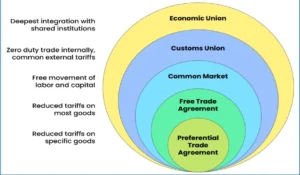
- A pact between two or more countries to reduce or eliminate tariffs, quotas, and trade barriers on goods and services.
- Scope: Primarily focuses on trade in goods and services.
- Examples:
- India–Sri Lanka FTA (1998)
- India–ASEAN FTA (2010)
- Objective: Promote market access and boost bilateral trade by lowering customs duties.
COMPREHENSIVE ECONOMIC PARTNERSHIP AGREEMENT (CEPA)
- Definition: A broader agreement that goes beyond FTAs, covering trade in goods, services, investment, intellectual property, competition, and dispute settlement.
- Scope: Includes economic cooperation, regulatory harmonisation, and longterm partnership mechanisms.
- Examples:
- India–UAE CEPA (2022)
- India–Japan CEPA (2011)
- Objective: Build a strategic economic partnership, not just tariff reduction.
Conclusion:
The India–UK CETA is more than a tariff deal — it is a test of India’s ability to compete confidently in global markets, turning external competition into a driver of domestic improvement.
POPULATION, TAXATION AND REPRESENTATION AND INDIA’S FEDERAL BALANCE
TOPIC: (GS3) ECONOMY: THE HINDU
The delimitation of Lok Sabha and Assembly seats, raises concerns over federal balance, as highpopulation northern states may gain representation while southern states that achieved fertility decline could lose political weight.
Delimitation in India
- Delimitation is the process of redrawing boundaries of Lok Sabha and State Assembly constituencies to reflect changes in population, ensuring equal representation.
- Authority: Conducted by the Delimitation Commission, a statutory body appointed by the Government of India under the Delimitation Acts (based on Census data).
- Purpose: Ensures that each constituency has roughly equal population, upholds the principle of “one person, one vote, one value”, and maintains fairness in democratic representation.
Delimitation History in India
- First Exercises: Conducted in 1952, 1963, and 1973 based on the 1951, 1961, and 1971 Censuses. These commissions fixed the number of seats and redrew constituency boundaries to reflect population changes.
- Freeze on Seats: The 42nd Constitutional Amendment (1976) froze delimitation until 2001, using the 1971 Census as the base. Aim: avoid penalising states that successfully controlled population growth.
- Extension of Freeze: The 84th Amendment (2001) extended the freeze until 2026, though boundaries were adjusted for fairness without changing seat numbers.
- Upcoming Exercise: After 2026, seats in Lok Sabha and State Assemblies will be reallocated based on the latest Census, likely increasing representation for highpopulation northern states and reducing weight for southern states with lower fertility.
Key Issues
- Delimitation Challenge: Post2026, seat allocation may shift towards highpopulation states, reducing political weight of states with better demographic management.
- Equity vs Efficiency: Richer states demand fair recognition of their fiscal contributions, while poorer states argue for representation based on population.
- Governance Impact: Unequal representation could affect policymaking, resource distribution, and centre–state relations.
- Changing Communication: With digital outreach, MPs no longer rely solely on physical constituency visits, raising questions about whether population should remain the sole determinant of representation.
Wider Implications of Delimitation Debate
- Fiscal Federalism: Finance Commission allocations already balance tax contributions and developmental needs. For instance, the 16th Finance Commission (2026–31) retained states’ share in central taxes at 41%, while rewarding states for GDP contribution and demographic performance.
- Comparative Example — USA: In the United States, representation in the House of Representatives is strictly populationbased, but federal transfers (Medicaid, infrastructure grants) balance inequalities between richer and poorer states.
- Policy Innovation: India may need hybrid models that combine population with economic contribution, governance performance, and social indicators. This would prevent penalising states that achieved fertility decline while ensuring fair representation.
- Demographic Divide: Southern states like Kerala (TFR 1.6) and Tamil Nadu (TFR 1.7) face ageing populations, while northern states like Bihar (TFR 2.9) and Uttar Pradesh (TFR 2.6) have youthful populations. This divergence complicates seat allocation and resource distribution.
- Governance and Technology: With digital outreach, MPs increasingly connect with voters through social media and messaging platforms rather than physical visits. This raises questions about whether population size alone should remain the determinant of representation in the 21st century.
Challenges
- Regional Divide: India’s national TFR is 1.9 (2024), but stark contrasts exist between ageing south and youthful north.
- Economic Angle: Southern states may face labour shortages, while northern states risk unemployment if youth are not skilled.
- Governance Challenge: Federal resource allocation must balance ageingrelated welfare in the south with job creation in the north.
- Comparative Example: Similar demographic divides exist in China (east vs west) and Europe (north vs south), showing global relevance.
Conclusion:
India’s upcoming delimitation will test the balance between populationbased representation and fiscal equity, shaping the future of federalism and democratic fairness.
HUMAN–LION CONFLICT IN GUJARAT
TOPIC: (GS3) ENVIRONMENT: THE HINDU
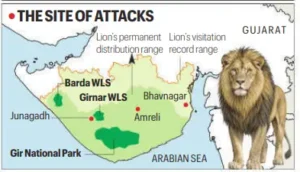
The Gujarat Forest Department captured 31 Asiatic lions, declaring 7 as “maneaters,” after a surge of attacks left six people dead. The state has sought help from the Wildlife Institute of India (WII) to study changes in lion behaviour and recommend solutions.
Background of the Issue
- Region of Conflict: Incidents reported in Bhavnagar, Amreli, Junagadh districts adjoining Gir National Park and nearby sanctuaries.
- Population Status: Asiatic lion numbers have risen to ~891 (2025 census), leading to expansion beyond core Gir habitat.
- Habitat Pressure: Increasing lion movement into farmlands and villages due to shrinking prey base and corridor fragmentation.
- Conflict Trigger: Rising encounters with humans, livestock predation, and retaliatory actions highlight governance and ecological challenges.
Human–Wildlife Conflict in India
- Man–animal conflict refers to negative interactions between humans and wildlife that result in loss of life, injury, crop damage, livestock predation, or property destruction.
- Human toll: ~500 deaths annually due to elephants; lions and leopards also cause fatalities in Gujarat and Maharashtra.
- Wildlife mortality: ~100 elephants die annually from electrocution, train collisions, poaching.
- Tiger deaths: 166 recorded in 2025, highest since 1973.
- Economic impact: ~5 lakh families affected yearly by crop raiding; livestock losses push marginal farmers into debt.
Causes of Rising Conflict
- Habitat expansion: Lions moving beyond Gir into humandominated landscapes like farms and villages.
- Prey depletion: Decline in wild prey pushes lions towards livestock.
- Human encroachment: Roads, mining, and settlements fragment lion corridors.
- Behavioural change: Experts suggest lions are adapting to new habitats, increasing encounters with people.
Impact on Communities
- Human casualties: Multiple deaths and injuries in villages near Gir.
- Livelihood loss: Farmers lose cattle, goats and buffaloes to predation.
- Fear and insecurity: Villagers face psychological stress and demand stronger protection measures.
Government Response
- Lion relocation: 31 lions captured; 7 identified as habitual attackers.
- Scientific study: WII tasked with analysing behavioural shifts and ecological pressures.
- Compensation: State provides relief for livestock loss and human casualties.
- Monitoring: Use of camera traps, GPS collars, and patrols to track lion movements.
Way Forward
- Strengthen wildlife corridors to reduce habitat fragmentation.
- Promote communitybased conservation with local participation.
- Enhance ecosensitive zones around Gir and adjoining sanctuaries.
- Explore relocation of some lions to Madhya Pradesh’s Kuno National Park for population dispersal.
ASIATIC LIONS
- Scientific name: Panthera leo leo (earlier P. l. persica).
- Range: Historically across West Asia and northern India; now restricted to Gir National Park and surrounding areas in Gujarat.
- Population: ~891 in the wild (2025 census); ~400 in captivity across India and Europe.
- Physical traits: Smaller than African lions; males weigh 160–190 kg, females 110–120 kg. Distinctive abdominal skin fold and shorter mane with visible ears.
- Conservation status: Listed as Vulnerable by IUCN (2024 revision); Schedule I under India’s Wildlife Protection Act, 1972.
- Ecological role: Apex predator regulating herbivore populations, maintaining ecosystem balance.
Conclusion:
The Gujarat lion conflict shows that successful species recovery must be matched with coexistence strategies, balancing conservation with community safety.
ANUSANDHAN NATIONAL RESEARCH FOUNDATION AND INDIA’S INNOVATION ECOSYSTEM
TOPIC: (GS3) SCIENCE AND TECHNOLOGY: THE HINDU
The Anusandhan National Research Foundation (ANRF) has been highlighted as a key institution to strengthen India’s research, innovation, and academia–industry partnerships. Experts stress that India’s technological progress requires collective efforts from government, private sector, and universities.
Background
- Establishment: ANRF was set up under the ANRF Act, 2023 to replace the Science and Engineering Research Board (SERB).
- Objective: To provide funding, coordination, and policy support for research and development (R&D) across disciplines.
- Vision: Build a strong innovation ecosystem that links deeptech startups, academia, and industry.
Key Features of ANRF
- Funding Support: Mobilises resources from government and private sector to finance R&D projects.
- Partnership Model: Encourages collaboration between universities, research labs, and industry players.
- Focus Areas: Prioritises deep technology, AI, clean energy, biotechnology, and defence innovation.
- Capacity Building: Strengthens research infrastructure in higher education institutions.
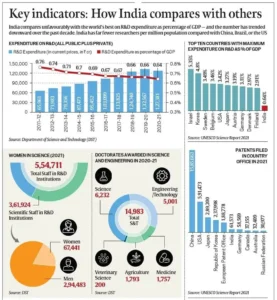
- Global Benchmarking: Aims to raise India’s R&D spending closer to 2% of GDP, compared to current ~0.7%.
Importance for India’s Development
- Economic Growth: Innovation drives productivity, competitiveness, and job creation.
- SelfReliance: Supports Atmanirbhar Bharat by reducing dependence on imported technologies.
- Global Standing: Helps India climb higher in the Global Innovation Index (India ranked 40th in 2023).
- Social Impact: Research in health, agriculture, and climate resilience improves quality of life.
Challenges
- Low R&D Spending: India invests less than 1% of GDP in R&D, far below countries like South Korea (~4.8%).
- Brain Drain: Many researchers migrate abroad due to better opportunities.
- Fragmented Ecosystem: Lack of coordination between universities, labs, and industry.
- Private Sector Role: Industry contribution to R&D remains limited compared to global standards.
Conclusion:
The ANRF represents India’s resolve to build a worldclass innovation ecosystem, where academia, industry, and government work together to achieve technological selfreliance and global competitiveness.

OPERATION SOUTHERN READINESS
TOPIC: (GS3) SEQURITY: THE HINDU
The Indian Navy is hosting Operation Southern Readiness 262 at the Southern Naval Command, Kochi. This multinational exercise under Combined Maritime Forces (CMF) aims to strengthen regional maritime security and capacity building.
About the Exercise
- Nature: A fourday multinational maritime training engagement led by the Indian Navy under Combined Task Force 154 (CTF154).
- Participants: Personnel from 40+ CMF partner nations join for joint training, exchange of best practices, and interoperability.
- Training Modules: Classroom sessions, simulator drills, and handson exposure onboard Indian naval ships.
Key Focus Areas
- Maritime Law & Awareness: Legal frameworks, domain awareness, and information sharing.
- Security Operations: Counternarcotics, force protection, and asymmetric threat response.
- Technology Integration: Use of maritime uncrewed systems and advanced communications.
- Survival & Safety: Damage control, firefighting, boarding procedures, and survival at sea.
Significance for India
- Regional Leadership: Showcases India’s leadership in multinational maritime security under CMF.
- Capacity Building: Enhances skills of partner nations, especially smaller navies.
- Strategic Angle: Supports India’s SAGAR vision (Security and Growth for All in the Region) and IndoPacific outreach.
- UPSC Linkages: Comparable to Exercise Malabar and RIMPAC, highlighting India’s growing role in cooperative security frameworks.
Conclusion:
Operation Southern Readiness 262 reinforces India’s position as a trusted maritime partner, advancing collective security and regional stability in the IndoPacific.
PARIVARTAN SCHEME
TOPIC: (GS3) ECONOMY: THE HINDU
The Ministry of Housing & Urban Affairs (MoHUA) has approved guidelines for the PARIVARTAN Scheme. It seeks to replace old, polluting trucks and buses in the National Capital Region (NCR) with cleaner BSVI or electric vehicles.
About the Scheme
- Meaning: Programme for Accelerated Renewal and Incentivization of Vehicle Assets for Reducing Transport Air Pollution and Network Emissions.
- Implementing Agency: Ministry of Road Transport & Highways (MoRTH).
- Funding: Supported by the National Capital Region Planning Board (NCRPB).
- Coverage: Rajasthan, Haryana, Uttar Pradesh, and NCT of Delhi.
Incentives Offered
- Tax Relief: Motor Vehicle Tax concessions and registration fee waivers.
- Loan Support: 5% interest subvention on vehicle loans.
- OEM Discounts: Minimum 8% discount on new vehicles from manufacturers.
- Fuel Vouchers: Monthly fuel voucher support for diesel and CNG replacement vehicles.
- Electric Vehicles: Onetime financial assistance and Certificate of Deposit (CoD) trading for EV replacements.
Implementation Features
- Digital Platform: Integrated system linked with VAHAN, VScrap, DigiELV, PFMS, and lenders.
- Training & Monitoring: Ensures transparent tracking of scrappage, financing, and incentives.
Significance
- Air Pollution Control: NCR is among the world’s most polluted regions; scheme reduces vehicular emissions.
- Climate Goals: Supports India’s COP26 commitments and National Electric Mobility Mission Plan.
- Economic Angle: Boosts demand for cleaner vehicles, supporting auto industry transition.
- UPSC Linkages: Connect with Vehicle Scrappage Policy 2021, FAMEII scheme, and National Clean Air Programme (NCAP).
Conclusion:
The PARIVARTAN Scheme is a step towards cleaner mobility and healthier air in NCR, aligning transport policy with India’s climate and public health priorities.