Table of Contents
ToggleIndia–UK CETA and Economic Relations
Why in News?
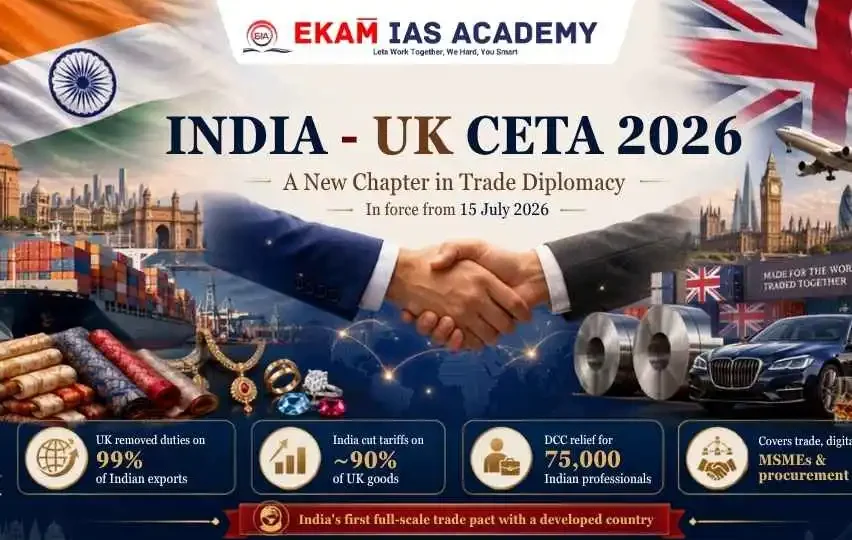
The India–UK Comprehensive Economic and Trade Agreement (CETA) came into force on 15 July 2026, along with the Double Contribution Convention (DCC).
It is India’s first full-scale trade pact with a developed country and has been described as a “gold standard” Free Trade Agreement. The agreement marks a major step in India’s trade diplomacy and economic partnership with the United Kingdom.
What is India–UK CETA?
The India–UK CETA is a comprehensive trade agreement covering nearly 30 chapters. It includes areas such as tariffs, digital trade, MSMEs, labour, gender, environment and government procurement.
The agreement aims to improve market access, reduce trade barriers, promote services trade and strengthen long-term economic cooperation between India and the UK.
Key Features of the Agreement
Tariff Elimination by the UK
The United Kingdom has removed duties on 99% of Indian exports, giving Indian goods near-total access to the UK market.
This is expected to benefit sectors where India has strong export potential.
Tariff Reduction by India
India has reduced tariffs on around 90% of UK goods. These reductions will be implemented through phased cuts and quota-based concessions.
Non-Tariff Barriers
The agreement addresses Sanitary and Phytosanitary standards and Technical Barriers to Trade. This will make compliance easier for Indian exporters and reduce regulatory hurdles.
Gains for India
Labour-Intensive Exports
Indian exports such as textiles, footwear, gems and jewellery are expected to gain from the removal of UK tariffs.
Steel Exports
Quota-based access is expected to push India’s steel exports to the UK beyond $1 billion.
Services Access
Indian firms in IT, consultancy and environmental services can establish branches in the UK, improving India’s services trade presence.
Government Procurement
Indian suppliers will gain access to the UK’s government procurement market, valued at around £90 billion, while India retains preference for domestic suppliers at home.
Worker Relief through DCC
Under the Double Contribution Convention, around 75,000 Indian professionals are exempted from double social-security payments. This can save nearly 23% of salaries for eligible professionals.
Gains for the UK and Indian Consumers
Indian consumers may benefit from cheaper imports due to tariff reductions on British products such as cars, whisky, chocolates and cosmetics.
Automobiles
Duties on British cars will be reduced from 110% to 30% initially, and further to 10% by the fifth year.
Alcohol
Whisky tariffs will be reduced from 150% to 75%, and later to 40% by the tenth year.
Services
UK firms will gain improved access to Indian markets in sectors such as accounting, finance and telecom. The agreement also supports recognition of UK professional qualifications.
Customs and Regulatory Innovations
Self-Declaration of Origin
For the first time in an Indian FTA, exporters can certify origin by themselves. This simplifies trade procedures and reduces compliance delays.
Medical Devices
Tariffs on medical devices have been removed, which may help reduce dependence on Chinese imports and improve access to quality equipment.
Template for Future FTAs
The agreement may become a model for India’s future trade negotiations with the European Union and the United States.
Challenges Ahead
Carbon Border Adjustment Mechanism
India has not secured exemption from the UK’s upcoming Carbon Border Adjustment Mechanism, which is expected to begin in 2027.
Compliance Costs
Exporters in carbon-intensive sectors such as steel and cement may face higher compliance costs due to climate-linked trade rules.
Implementation Challenges
Strong monitoring will be needed to ensure that MSMEs and smaller exporters actually benefit from the agreement.
Conclusion
The India–UK CETA is a landmark agreement in India’s trade diplomacy. It expands export opportunities, improves market access, protects Indian professionals from double social-security payments and sets new benchmarks for future FTAs. However, climate-linked trade barriers such as CBAM remain a major challenge, making implementation and exporter preparedness crucial for long-term success.



India–UK CETA and Economic Relations-FAQs Answered
Why is India–UK CETA in news?
India–UK CETA came into force on 15 July 2026 along with the Double Contribution Convention, marking India’s first full-scale trade pact with a developed country.
What does India–UK CETA cover?
The agreement covers around 30 chapters, including tariffs, digital trade, MSMEs, labour, gender, environment, government procurement and non-tariff barriers.
How will India benefit from India–UK CETA?
India will benefit through better access for textiles, footwear, gems and jewellery, steel exports, IT services, consultancy firms and government procurement opportunities in the UK.
What is the Double Contribution Convention?
The Double Contribution Convention exempts eligible Indian professionals in the UK from double social-security payments, helping them save a part of their salaries.
What are the key challenges in India–UK CETA?
Major challenges include the UK’s Carbon Border Adjustment Mechanism, compliance costs for steel and cement exporters, and ensuring that MSMEs fully benefit from the agreement.