

Table of Contents
ToggleA Trade Deal That Tests India’s Competitive Confidence
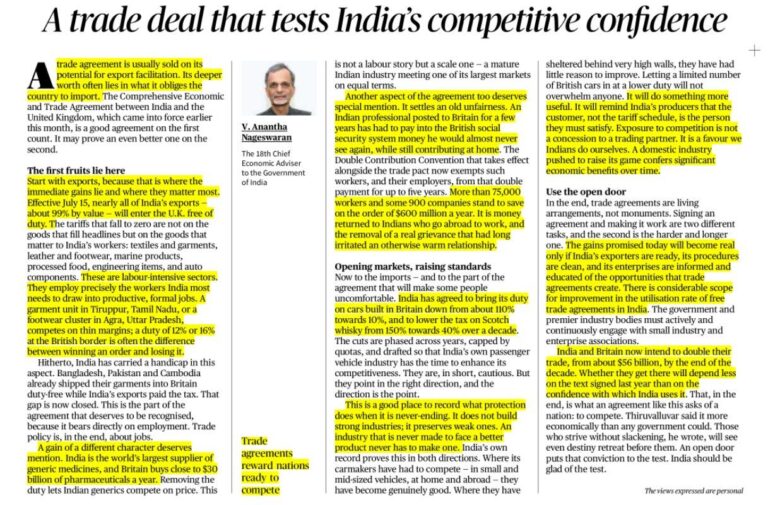
The article discusses the India–UK Comprehensive Economic and Trade Agreement (CETA) and argues that its real value lies not only in boosting exports but also in testing India’s ability to compete globally. Trade agreements benefit countries that are prepared to use open markets as an opportunity for productivity, efficiency and industrial upgrading.
Export Gains for India
Labour-Intensive Sectors Benefit
The agreement gives nearly 99% of Indian exports duty-free access to the UK market. This is especially important for labour-intensive sectors such as textiles, garments, leather, footwear, marine products, processed food, engineering goods and auto components.
These sectors employ large numbers of workers. Even small tariff differences can decide whether Indian producers win or lose export orders.
Pharmaceuticals and Services
India, being a major supplier of generic medicines, can gain from better market access in the UK. The article highlights that Indian pharmaceutical firms may compete more effectively due to tariff benefits and cost competitiveness.
The agreement also addresses an old concern faced by Indian professionals working in Britain. Under the Double Contribution Convention, Indian workers and employers will be exempt from double social security payments for a fixed period, reducing costs and improving mobility.
Import Competition and Domestic Industry
Opening Markets, Raising Standards
The agreement also reduces Indian duties on some British products such as cars and whisky in a phased manner. While this may create concern among some domestic producers, the article argues that competition is not always harmful.
Protection may shelter weak industries, but exposure to competition pushes firms to improve quality, efficiency and customer focus. The real test is whether Indian industry can use this opportunity to become globally competitive.
Need for Preparedness
Trade agreements succeed only when exporters are ready. India must ensure clean production standards, better logistics, awareness among MSMEs and stronger engagement between government and industry.
Conclusion
The India–UK trade deal is not just about tariffs; it is about India’s confidence to compete. It rewards sectors that are ready for global markets and pushes others to improve. For UPSC aspirants, this topic is important under international trade, FTAs, India–UK relations, MSMEs, exports, industrial policy and economic reforms.
Vocabulary Boost
• CETA → Comprehensive Economic and Trade Agreement.
• Tariff → Tax imposed on imports.
• Market Access → Entry into a foreign market.
• Competitiveness → Ability to compete efficiently in markets.
• Double Contribution Convention → Relief from dual social-security payments.
Frequently Asked Questions (FAQs)
What is the India–UK Comprehensive Economic and Trade Agreement (CETA)?
India–UK CETA is a trade agreement aimed at increasing market access, reducing tariffs and strengthening economic cooperation between the two countries.
How will CETA benefit Indian exporters?
The agreement provides duty-free access for nearly 99% of Indian exports to the UK, benefiting sectors like textiles, footwear, pharmaceuticals, engineering goods and processed food.
What is the Double Contribution Convention (DCC)?
The DCC prevents Indian workers and companies from paying social security contributions in both India and the UK for a specified period.
How will increased competition affect Indian industries?
Greater competition can encourage Indian industries to improve quality, efficiency, innovation and global competitiveness instead of depending on protection.
Why is the India–UK trade deal important for UPSC?
It is important under international trade, free trade agreements (FTAs), India–UK relations, MSMEs, export promotion and economic reforms.
Source From : The Hindu
India Now Has the Funds, the Talent and the Opening for a Research Leap
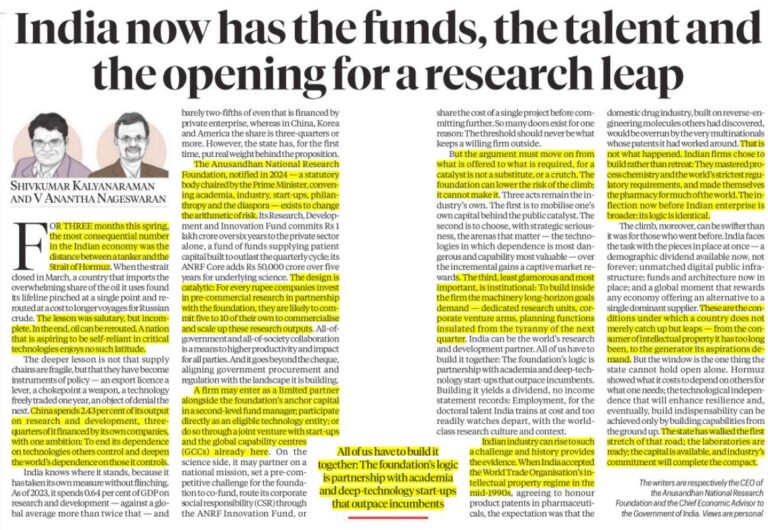
The article argues that India has reached a crucial stage where it possesses financial resources, scientific talent and institutional opportunities to transform into a global research and innovation hub. However, achieving this requires stronger collaboration between government, academia, industry and deep-tech startups.
India’s Research Challenge
Low Research Investment
India’s research and development (R&D) spending remains lower compared to major economies. While countries like China, South Korea and the United States invest significantly in science and technology, India’s R&D expenditure as a share of GDP remains limited.
The challenge is not only increasing funds but also creating an ecosystem where research outcomes can be converted into innovation and commercial products.
Anusandhan National Research Foundation (ANRF)
Strengthening Research Ecosystem
The article highlights the role of the Anusandhan National Research Foundation (ANRF), established under the ANRF Act, 2023.
Key objectives:
- Promote collaboration between academia, industry and government.
- Increase private sector participation in research.
- Support high-impact scientific projects.
- Encourage innovation and deep-tech development.
The ANRF Innovation Fund aims to provide financial support to promising research initiatives and startups.
Need for Industry-Academia Partnership
Moving Beyond Traditional Research
India must encourage partnerships between universities, research institutions and industries. The foundation should not only fund research but also help create pathways for commercialisation.
Deep-tech sectors such as:
- Artificial Intelligence
- Semiconductors
- Biotechnology
- Advanced materials
- Defence technology
require long-term investment and institutional support.
Learning from Global Models
Countries like China, South Korea and the United States have built strong innovation ecosystems through:
- High R&D spending
- Industry-led research
- University partnerships
- Technology transfer mechanisms
India needs similar structures while adapting them to its own strengths.
India’s Opportunity
India has several advantages:
- Large pool of scientific talent
- Growing startup ecosystem
- Expanding digital infrastructure
- Young workforce
- Increasing global interest in alternative technology supply chains
The focus should shift from merely consuming technology to becoming a creator of advanced technologies.
Conclusion
India has the resources and talent needed for a research revolution, but success depends on building strong institutions, encouraging private investment and creating a culture of innovation. For UPSC aspirants, this topic is important under science and technology, innovation policy, economic development, startups, research ecosystem and human capital.
Vocabulary Boost
ANRF → Anusandhan National Research Foundation.
Patient Capital → Long-term investment supporting innovation.
Commercialisation → Converting research into marketable products.
Technology Transfer → Movement of knowledge from research to industry.
Technological Self-Reliance → Indigenous capability to develop critical technologies.
Frequently Asked Questions (FAQs)
What is the main argument of the article?
The article argues that India has the funds, scientific talent and opportunity to achieve a major research and innovation breakthrough.
What is the role of the Anusandhan National Research Foundation (ANRF)?
ANRF aims to strengthen India’s research ecosystem by promoting collaboration between academia, industry, startups and government.
Why is industry–academia partnership important for research?
Industry–academia collaboration helps convert scientific discoveries into practical technologies, products and commercial innovations.
Which sectors can benefit from increased research investment?
Deep-tech sectors such as artificial intelligence, semiconductors, biotechnology, advanced materials and defence technology can benefit significantly.
Why is this topic important for UPSC?
It is important under science and technology, innovation policy, economic development, startups, research ecosystem and human capital development.