

...
Daily Current affairs 22 August 2026

Daily Current Affairs 22-August-2026

Share this Post

CENSUS 2027 QUESTIONNAIRE AND PRIVACY CONCERNS

TOPIC: (GS2) POLITY: THE HINDU

The Census 2027 questionnaire has introduced 40 questions, including 14 new or modified questions, several of which overlap with information earlier proposed under the National Population Register (NPR).

Census in India

  • The Census is India’s largest exercise for collecting demographic, social and economic information.
  • It provides essential data for policy formulation, welfare delivery, resource allocation and administrative planning.
  • Traditionally, Census information has focused on age, sex, literacy, education, occupation, housing and socio-economic characteristics.
  • A significant feature of Census 2027 is the proposed collection of caste-related information beyond the traditional SC/ST enumeration.

Key Changes in Census 2027

Important new or modified areas include:

  • Nationality as declared
  • Father’s and mother’s particulars
  • Caste, SC and ST status
  • Literacy and digital literacy
  • Highest educational qualification and stream
  • Place of COVID-19 vaccination
  • Number of bank accounts
  • Mobile number and identity documents such as Aadhaar, voter ID, passport and driving licence.

Link with National Population Register

  • NPR is a register of the country’s usual residents, not exclusively citizens.
  • A usual resident is generally one who has lived in an area for six months or intends to stay for the next six months.
  • NPR was first prepared in 2010 and updated in 2015.
  • Eight Census 2027 questions reportedly overlap with the NPR schedule prepared for the proposed 2020 exercise.
  • Parental details became particularly sensitive because the earlier NPR framework sought information regarding parents’ date and place of birth.

Why is this Significant?

  • Targeted welfare delivery
  • Identifying beneficiaries
  • Reducing duplication in government records
  • Improving administrative efficiency
  • Reconciling discrepancies across databases.

The government had earlier clarified that parental details in the NPR exercise were optional and that lack of such information would not automatically affect citizenship.

Privacy Concerns

The inclusion of mobile numbers and identity-document details raises concerns about:

  • Data storage and security
  • Who can access the information
  • Purpose and legal limits of its use
  • Possibility of database linkage
  • Risk of unauthorised access or misuse.

The Supreme Court’s recognition of privacy as a fundamental right under Article 21 makes data governance an important constitutional dimension.

Conclusion

Census 2027 can significantly improve India’s evidence-based governance, especially through updated socio-economic and caste data. However, comprehensive data collection must be accompanied by strong privacy safeguards and transparency to maintain citizens’ trust.

POLITICAL CLEARANCE FOR FOREIGN TRIPS AND MEA APPROVAL

TOPIC: (GS2) POLITY: THE HINDU

Telangana Chief Minister A. Revanth Reddy had to cancel the US leg of his proposed UK-US tour after the Ministry of External Affairs (MEA) did not grant political clearance.

What is Political Clearance?

  • Political clearance is permission granted by the MEA before government officials undertake foreign visits.
  • It applies to official as well as certain private foreign visits of public officials.
  • The purpose is to ensure that foreign engagements do not create unassessed diplomatic or foreign-policy implications.
  • Factors considered include:
    • Nature of the event
    • Level of foreign participation
    • Nature of invitation
    • India’s diplomatic relations with the host country
  • Since 2016, applications have been processed online through the e-political clearance system.

Why Do Chief Ministers Need MEA Clearance?

  • Foreign affairs fall within the Union’s domain under the Constitution.
  • A Chief Minister represents a State government but may interact with foreign governments, diplomats and international institutions during overseas visits.
  • Such interactions can have implications for India’s foreign policy and diplomatic relations.
  • Hence, prior coordination with the MEA ensures that State-level engagements remain consistent with national foreign-policy objectives.

Other Clearances

For Chief Ministers, Ministers and UT Ministers:

  • Prior MEA political clearance is required.
  • FCRA clearance may be required where foreign contributions or hospitality are involved.
  • Department of Economic Affairs (DEA) clearance is also applicable in specified cases.
  • Applications to other authorities are processed after the required MEA clearance.

Clearance Framework for Others

  • Union Ministers: MEA clearance + Prime Minister’s approval.
  • Lok Sabha MPs: Permission from the Speaker.
  • Rajya Sabha MPs: Permission from the Chairperson.
  • Officials up to Joint Secretary level: Concerned Minister’s approval after MEA clearance.
  • Officials above Joint Secretary level: Screening Committee of Secretaries (ScoS) approval.
  • Government employees generally require approval for foreign travel, including private visits.

Constitutional & Federal Dimension

  • Article 246 and the Union List place foreign affairs and diplomatic relations within Parliament/Union jurisdiction.
  • However, States increasingly engage with foreign countries for investment, technology, tourism, education and trade promotion.
  • This creates a need for cooperative federalism, where States can pursue legitimate economic interests while remaining aligned with national foreign policy.

Concerns

  • Delay and lack of transparency in the clearance process can disrupt official schedules.
  • Critics argue that the system may restrict legitimate international engagement by elected State governments.
  • The Centre, however, maintains that assessing the suitability and diplomatic desirability of foreign engagements is an essential MEA function.

Conclusion

Political clearance serves as a diplomatic safeguard, ensuring that foreign visits by public officials do not conflict with India’s external interests.

INDIA’S SUGAR PRICE SURGE AND ETHANOL

TOPIC: (GS3) ECONOMY: THE HINDU

India has witnessed a sharp rise in sugar prices, with retail prices reaching around ₹65/kg in some markets during August 2026.

Reasons Behind the Price Rise

  1. Lower Sugar Production
    • Sugar production is estimated at around 30.6 million tonnes, against the initial estimate of 34.3 million tonnes.
    • Excess rainfall, waterlogging, red rot disease and top borer pests affected sugarcane production.
    • Maharashtra, Karnataka and Gujarat were particularly affected by weather-related crop damage.
  1. Declining Stocks
    • Closing stocks are projected at around 41 lakh tonnes, among the lowest levels in recent years.
    • Lower availability has increased pressure on domestic prices.
  1. Festive Demand
    • Demand generally rises before Dussehra and Diwali due to increased consumption of sweets and processed foods.
  1. Global Market Conditions
    • International sugar prices increased by over 16% during June–August 2026.
    • A projected global sugar deficit has added pressure to domestic prices.
  1. Hoarding and Speculation
    • Stock-holding and speculative buying by some market participants have contributed to artificial price pressure.

Is Ethanol Diversion Responsible?

  • The government has rejected ethanol diversion as the primary cause of the price surge.
  • Sugar diverted for ethanol declined from around 12% in 2022-23 to about 9% in 2025-26.
  • Nearly three-fourths of ethanol production now comes from grains, particularly maize.
  • The ethanol programme has helped manage India’s traditional structural sugar surplus and improved the financial position of sugar mills.

Government Measures

  • Stock limit: Dealers restricted to 400 tonnes of sugar until November 30.
  • Duty-free imports: Up to 10 lakh tonnes of raw sugar permitted.
  • Export restriction: Sugar exports banned until September 30, 2026.
  • Stock verification: Central and State teams to check actual mill inventories.
  • Bulk consumer monitoring: Large buyers to provide purchase details.
  • Early crushing: Mills encouraged to begin crushing from October 15 to improve supply.

Ethanol-Sugar Balance

India must balance two objectives:

  • Ethanol blending: Supports energy security, reduces fossil-fuel dependence and provides an alternative market for sugarcane.
  • Sugar security: Excessive diversion during a production shortfall can tighten domestic availability and increase consumer prices.

Way Forward

  • Improve climate-resilient sugarcane varieties, irrigation and pest management.
  • Maintain adequate strategic sugar stocks.
  • Strengthen monitoring against hoarding and speculative stocking.
  • Adopt a flexible ethanol policy based on annual sugar production and stock levels.

Conclusion

The current price surge appears primarily linked to production losses, weather shocks, lower stocks and seasonal demand, rather than a rising diversion of sugar towards ethanol. India therefore needs a dynamic balance between food security, farmer income, sugar-mill viability and energy security.

VANASHAKTI VERDICT AND DEVELOPMENT

TOPIC: (GS3) ENVIRONMENT: THE HINDU

The Supreme Court’s July 2026 Vanashakti judgment reconsidered the legality of ex-post facto Environmental Clearance (EC) for projects that began without obtaining prior approval.

Background

  • Under the EIA Notification, 2006, specified projects must obtain prior environmental clearance before commencement of construction or activity.
  • The controversy arose from:
    • 2017 Notification, which provided a limited, time-bound opportunity for certain projects that had violated the prior-clearance requirement.
    • 2021 Office Memorandum (OM), which created a broader mechanism for processing ex-post facto ECs.

What Did the Supreme Court Decide?

  1. Prior EC is mandatory
    • The Court reaffirmed that projects covered by the 2006 regime cannot ordinarily begin construction without environmental clearance.
    • This reflects the precautionary principle—environmental risks should be assessed before damage occurs.
  1. 2021 Office Memorandum quashed
    • The Court held that the 2021 OM was an administrative instruction and could not substantially alter the statutory environmental-clearance framework.
    • It was also considered a perpetual amnesty mechanism, lacking adequate safeguards and differentiation between projects.
  1. 2017 Notification upheld
    • Unlike the 2021 OM, the 2017 measure was treated as a narrow, time-bound and legally authorised notification.
    • The Court recognised that exceptional measures may be possible when supported by proper statutory authority and overriding public interest.
  1. Existing clearances protected
    • Environmental clearances already granted under the 2017 Notification and 2021 OM were allowed to remain valid unless individually challenged.
    • Pending applications were directed to be dealt with according to law.
  1. Future executive amnesty barred
    • The Centre cannot create a fresh blanket system for retrospective EC merely through an Office Memorandum.
    • Any exceptional mechanism must have a proper legal basis, including a valid notification under the Environment (Protection) Act, 1986.

Constitutional and Environmental Principles

  • Article 21: Right to life includes the right to a clean and healthy environment.
  • Article 14: Environmental regulation must satisfy fairness and reasonableness.
  • Precautionary Principle: Prevent environmental harm where scientific uncertainty exists.
  • Sustainable Development: Development must balance economic growth with ecological protection.
  • Polluter Pays Principle: Those responsible for environmental damage should bear the cost of remediation.

Significance

  • Prevents businesses from treating environmental clearance as a post-construction formality.
  • Strengthens the role of Environmental Impact Assessment (EIA) as a preventive mechanism.
  • At the same time, the judgment avoids an excessively rigid approach by recognising limited exceptions in supervening public interest.
  • It also reinforces separation of powers, by holding that an executive OM cannot effectively rewrite delegated environmental legislation.

Way Forward

  • Ensure timely environmental clearances to reduce incentives for violations.
  • Strengthen monitoring and compliance after EC is granted.
  • Use exceptional amnesty provisions only when they are legally authorised, narrowly defined and time-bound.
  • Improve transparency through stronger public consultation, EIA quality and environmental audits.

Conclusion

The Vanashakti verdict seeks to balance environmental protection with developmental needs. It makes prior environmental clearance the norm, while permitting only legally grounded and exceptional flexibility in genuine public interest.

CHINA’S ANTELOPE REEF BASE

TOPIC: (GS1) GEOGRAPHY: THE HINDU

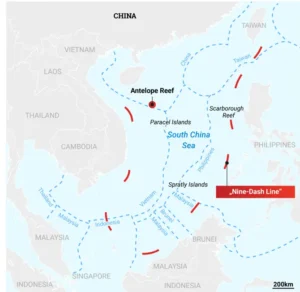
Recent satellite imagery shows that China has completed the first phase of land reclamation and infrastructure development at Antelope Reef in the disputed Paracel Islands.

Antelope Reef: Key Developments

  • The reclaimed area stretches nearly 6 km and includes:
    • Helicopter pad
    • 680-metre wharf connected to a deep-water harbour
    • Around 3-km straight coastline, potentially usable as a runway.
  • China officially describes the development as serving civilian purposes, including weather forecasting and scientific research.
  • However, analysts see potential for military deployment and naval operations.

Strategic Significance

  • Bastion Strategy: The reef could provide a protected maritime zone for China’s nuclear-armed ballistic-missile submarines, reducing their vulnerability to surveillance and naval operations.
  • It strengthens China’s ability to project naval power across the South China Sea.
  • The development could support China’s wider Maritime Silk Road and strategic presence towards the Indian Ocean.
Chinas Antelope Reef Base

South China Sea Dispute

  • The Paracel Islands are claimed by Vietnam, while China has maintained de facto control since 1974.
  • The South China Sea has overlapping claims involving China, Vietnam, Philippines, Malaysia, Brunei and Taiwan.
  • China’s Nine-Dash Line claims were rejected by the 2016 South China Sea Arbitral Tribunal, which held that historic rights beyond UNCLOS-based maritime entitlements had no legal basis.

Implications for India

  • Over 55% of India’s maritime trade passes through the South China Sea and Malacca Strait.
  • Greater Chinese militarisation could threaten Sea Lines of Communication (SLOCs) and maritime trade.
  • It may also increase Chinese naval access towards the Indian Ocean Region, challenging India’s strategic interests.

Conclusion

China’s activities at Antelope Reef highlight the growing militarisation and strategic competition in the South China Sea. India needs stronger maritime domain awareness, naval preparedness and regional partnerships to safeguard its trade routes and Indo-Pacific interests.

SATKOSIA TIGER RESERVE (STR)

TOPIC: (GS3) ENVIRONMENT: THE HINDU

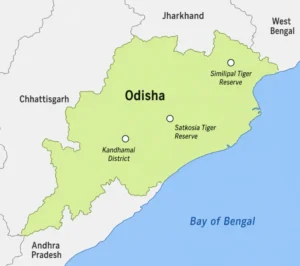
The Odisha Government has constituted a high-level inquiry committee into the relocation of villages from Satkosia Tiger Reserve following allegations of forced displacement.

About Satkosia Tiger Reserve

  • Location: Odisha, centred around the Mahanadi Gorge.
  • Established: Notified as a Tiger Reserve in 2007 by combining:
    • Satkosia Gorge Sanctuary – 1976
    • Baisipali Sanctuary – 1981
  • Geographical Significance: Located at the meeting point of the Deccan Peninsula and Eastern Ghats, making it ecologically diverse.
  • The reserve contains a 22.5-km-long gorge through which the Mahanadi flows.
  • Vegetation: Mainly mixed deciduous and riverine forests, including Sal.

Biodiversity

  • Important species include tiger, leopard, elephant, gaur, gharial, mugger crocodile, reptiles, amphibians and diverse birds and fish.
  • It forms part of the Mahanadi Elephant Reserve, contributing to elephant habitat connectivity.
Satkosia Tiger Reserve

Tiger Conservation Challenge

  • Tiger numbers declined from 12 in 2007 to one by 2018–19.
  • The 2022 tiger census recorded no tigers in the reserve.
  • In 2018, India attempted its first inter-State tiger relocation programme here by bringing tigers from Madhya Pradesh, but the initiative failed.
  • Odisha is considering fresh tiger supplementation.

Key Conservation Issue

  • The case highlights the challenge of balancing wildlife conservation with rights and livelihoods of forest-dependent communities.
  • Relocation must follow due process, including recognition of Forest Rights Act provisions, consent-related safeguards and proper rehabilitation.

Conclusion:

Scientific habitat management, effective compensation, community involvement and transparent relocation procedures can help create inviolate wildlife habitats without undermining legitimate community rights.


Write a Review

Your email address will not be published. Required fields are marked *

Seraphinite AcceleratorOptimized by Seraphinite Accelerator
Turns on site high speed to be attractive for people and search engines.