

Table of Contents
ToggleFood Security Act Reform: A Timely Reset for Nutrition Security
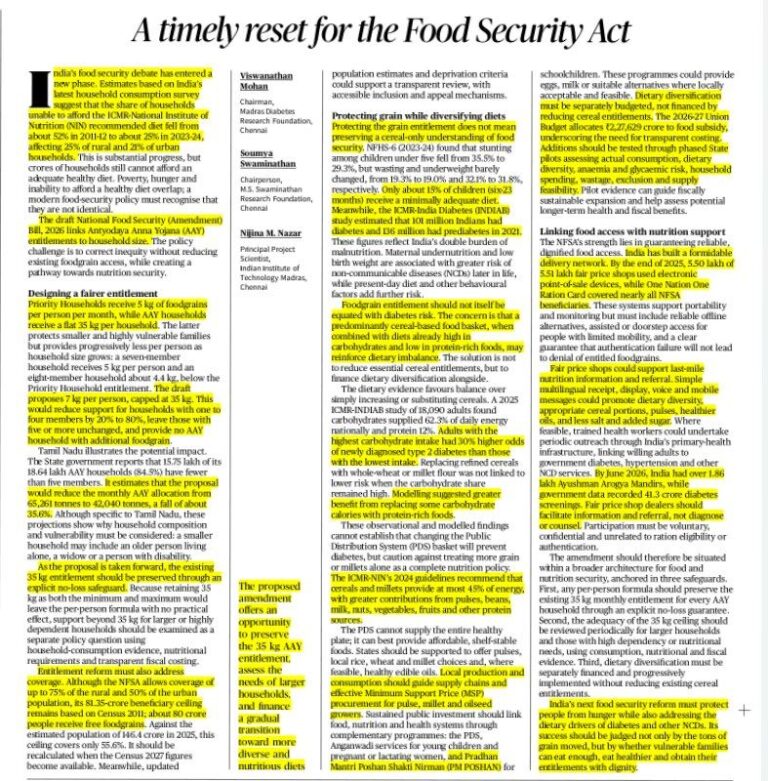
India’s National Food Security Act (NFSA), 2013 has played a crucial role in protecting millions of households from hunger by providing subsidised foodgrains through the Public Distribution System (PDS). However, changing family structures, nutritional deficiencies and rising lifestyle diseases have strengthened the case for a timely Food Security Act reform that moves beyond calorie security towards comprehensive nutrition security.
Why Does the National Food Security Act Need a Reset?
Under the NFSA, Priority Households receive 5 kg of foodgrains per person per month, while Antyodaya Anna Yojana (AAY) households receive 35 kg per household per month.
This creates challenges for larger AAY families. While smaller households receive relatively higher per-capita support, bigger families receive progressively less foodgrain per person because the entitlement remains fixed at 35 kg.
A proposed reform therefore seeks to retain the 35 kg minimum entitlement while considering additional support for larger households.
Updating NFSA Coverage and Beneficiary Identification
Another major concern is beneficiary identification. NFSA coverage is still linked to older population estimates, even though India’s population and socioeconomic conditions have changed substantially.
Periodic revision of beneficiary numbers using updated population estimates and deprivation indicators can improve targeting, reduce exclusion errors and ensure that vulnerable households continue receiving support.
From Food Security to Nutrition Security
India today faces a dual burden of undernutrition and rising obesity, diabetes and other non-communicable diseases.
Food security policies should therefore move beyond dependence on rice and wheat. Greater dietary diversification through pulses, millets, vegetables, fruits, milk and other protein-rich foods can improve household nutrition while supporting healthier consumption patterns.
Strengthening PDS Through Technology and Choice
The One Nation One Ration Card initiative has improved portability for migrant beneficiaries. However, reforms must also provide alternative authentication mechanisms, stronger grievance redressal and safeguards against digital exclusion.
Pilot programmes involving diversified food baskets, food vouchers or carefully designed cash support can also help assess what works best for different regions and communities.
Conclusion
India’s food security framework now needs to evolve from simply ensuring enough food to ensuring the right kind of food. Reforming the NFSA should focus on protecting existing entitlements, improving beneficiary identification, strengthening PDS delivery and promoting dietary diversity.
A future-ready food security system must ensure that every citizen can access adequate, affordable, nutritious and healthy food, making food security an integral part of India’s broader goal of nutrition security and human development.
Vocabulary
1. NFSA – National Food Security Act
2. AAY – Antyodaya Anna Yojana
3. Nutrition Security – Access to adequate and healthy diets
4. PDS – Public Distribution System
5. Dietary Diversification – Expanding food beyond cereals
Frequently Asked Questions (FAQs)
What is the National Food Security Act (NFSA), 2013?
The NFSA, 2013 provides subsidised foodgrains to eligible households through the Public Distribution System. It aims to strengthen food security and protect vulnerable populations from hunger.
Why is there a need to reform the Food Security Act?
Current entitlements and beneficiary coverage are based on older demographic conditions. Reforms are needed to better support larger households, update beneficiary identification and address changing nutritional needs.
How can NFSA promote nutrition security?
The food basket can be diversified beyond rice and wheat to include pulses, millets, vegetables, fruits and protein-rich foods. This can help address both undernutrition and rising lifestyle diseases.
What role does technology play in strengthening the PDS?
Initiatives such as One Nation One Ration Card improve portability, especially for migrant beneficiaries. However, alternative authentication systems and grievance mechanisms are essential to prevent digital exclusion.
What should be the future direction of India’s food security system?
India should move from simply ensuring adequate calories towards providing affordable, healthy and nutritious diets. Stronger PDS delivery, transparent beneficiary identification and dietary diversification should form the core of future reforms.
Source From : The Hindu
NREGA’s New Version: Promises, Problems and Rural Employment Concerns
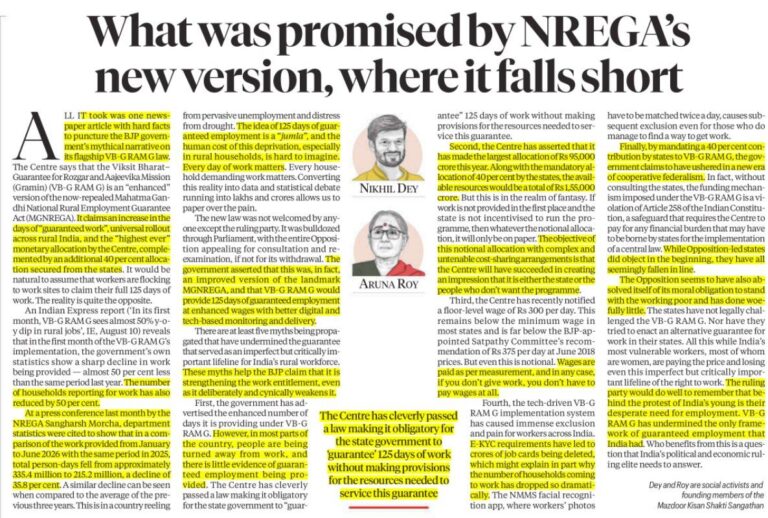
The Centre has projected the Viksit Bharat Guarantee for Rozgar and Aajeevika Mission (Gramin) — VB-G RAM G as an improved version of the Mahatma Gandhi National Rural Employment Guarantee Act (MGNREGA). The new framework promises 125 days of guaranteed rural employment, wider implementation, enhanced digital monitoring and greater financial support. However, concerns remain over whether these promises are translating into actual employment opportunities.
What Does the New NREGA Framework Promise?
A major highlight is the increase in guaranteed employment from 100 days to 125 days. The government has also highlighted a core allocation of around ₹95,000 crore, supplemented by a proposed 40% contribution from States, taking the overall resource pool higher.
The programme also emphasises technology-driven implementation, including digital monitoring, Aadhaar-based systems and electronic verification to improve transparency and accountability.
Why Are Concerns Being Raised?
The article argues that a higher statutory guarantee has little meaning if rural households are unable to obtain even the existing level of employment.
According to figures cited in the article, total person-days of work between January and June 2026 declined from about 335.4 million to 215.2 million, representing a fall of around 35.8%. The number of households reporting employment has also declined significantly.
This raises concerns that increasing the formal guarantee to 125 days may not automatically translate into more employment on the ground.
Funding and Federalism Challenges
Another major issue relates to the proposed Centre-State cost-sharing arrangement. Requiring States to bear 40% of programme expenditure could place additional pressure on States with limited fiscal capacity.
Critics argue that employment guarantees require predictable and adequate funding. If States struggle to provide their share, poorer regions with greater demand for rural employment could face disproportionately greater difficulties.
Technology and Exclusion Concerns
Digital systems such as Aadhaar authentication, e-KYC and app-based attendance monitoring are intended to improve transparency. However, technological barriers may also exclude workers facing connectivity problems, authentication failures or limited digital access.
A welfare programme must therefore combine technological accountability with accessible offline alternatives.
Conclusion
Strengthening rural employment requires more than increasing the number of guaranteed workdays on paper. The effectiveness of the new NREGA framework will depend on adequate funding, timely employment, fair wages, cooperative federalism and inclusive implementation.
For rural workers, the real test is whether the programme delivers employment when it is needed most. A credible employment guarantee must ensure that legal promises are matched by adequate resources and actual work opportunities.
Vocabulary
1. Employment Guarantee – Legal assurance of work
2. Demand-driven Scheme – Work provided when households seek it
3. Cost Sharing – Expenditure divided between Centre and States
4. Digital Exclusion – Denial caused by technological barriers
5. Cooperative Federalism – Centre–State partnership in governance
Frequently Asked Questions (FAQs)
What is the new NREGA framework?
The VB-G RAM G programme has been presented as an upgraded rural employment framework, with a promise of up to 125 days of guaranteed work along with stronger digital monitoring and expanded implementation.
Why are concerns being raised about the 125-day employment guarantee?
The article argues that a higher legal guarantee is meaningful only if adequate work is actually provided. Recent declines in person-days and household employment have raised doubts about implementation.
What are the funding concerns under the new framework?
The proposed 40% State contribution may increase fiscal pressure on poorer States. Inadequate or delayed funding could weaken the employment guarantee where rural distress is highest.
How can technology affect rural workers under the scheme?
Aadhaar authentication, e-KYC and app-based attendance can improve transparency, but they may also exclude workers facing connectivity, biometric or digital-access problems.
What is needed to make the new rural employment guarantee effective?
The programme needs adequate funding, timely employment, fair wages, reliable implementation and safeguards against digital exclusion. The real success of the scheme depends on actual work reaching rural households when they need it most.