Table of Contents
ToggleIndia’s 1st Hydrogen-Powered Train
Why in News?
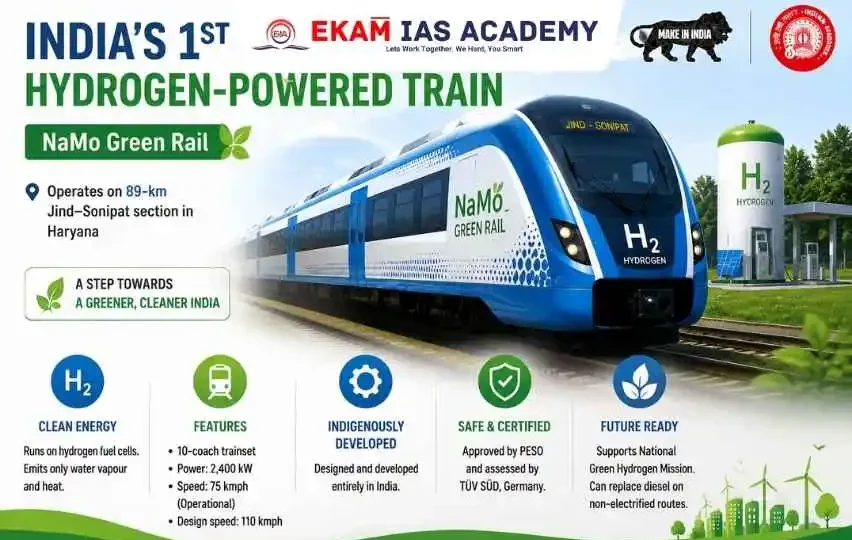
The Prime Minister recently flagged off India’s first hydrogen-powered train, named “NaMo Green Rail”. The train operates on the 89-km Jind–Sonipat section of Northern Railway in Haryana.
The project marks an important step towards introducing clean energy technologies in India’s railway sector and reducing dependence on diesel-based traction.
About the Project
The hydrogen-powered train project is a technology-demonstration initiative aimed at testing and validating:
- Hydrogen propulsion technology
- Refuelling systems
- Safety standards
- Operating procedures
- Maintenance practices
The project will help assess the feasibility of deploying hydrogen trains on suitable railway routes in the future.
Indigenous Development
The train has been designed and developed entirely in India.
The technical specifications for the project were prepared by the Research, Design and Standards Organisation (RDSO), the research and development organisation of Indian Railways.
This highlights India’s growing capability in developing advanced green transportation technologies.
Key Features of NaMo Green Rail
| Feature | Details |
|---|---|
| Name | NaMo Green Rail |
| Route | Jind–Sonipat section, Haryana |
| Operator | Northern Railway |
| Train Composition | 10 coaches |
| Power Cars | 2 Hydrogen Driving Power Cars |
| Trailer Coaches | 8 |
| Power Output | 1,200 kW per power car |
| Total Propulsion Capacity | 2,400 kW |
| Operational Speed | 75 kmph |
| Design Speed | 110 kmph |
Working Mechanism of Hydrogen Train
The train uses Proton Exchange Membrane (PEM) fuel cell technology.
The process involves:
- Hydrogen stored onboard is supplied to fuel cells.
- Hydrogen reacts electrochemically with oxygen from the air.
- This reaction generates electricity.
- The electricity powers traction motors that move the train.
- Lithium Iron Phosphate (LiFePO₄) batteries support acceleration and changing power requirements.
Unlike conventional diesel engines, fuel cells generate electricity without combustion.
Environmental Significance
Hydrogen-powered trains have major environmental benefits.
The direct by-products of the fuel-cell reaction are:
- Water vapour
- Heat
There are no smoke emissions or tailpipe carbon emissions during operation.
However, the overall environmental benefit depends on how hydrogen is produced.
- Green hydrogen produced using renewable energy provides maximum climate benefits.
- Hydrogen produced from fossil fuels may have a higher carbon footprint.
Safety and Regulation
Hydrogen is highly inflammable and requires advanced safety measures.
The train system includes:
- Specialised hydrogen storage systems
- Leak detection mechanisms
- Proper ventilation systems
- Automatic shutdown systems
The hydrogen storage and supply system has been approved by the Petroleum and Explosives Safety Organisation (PESO) and independently assessed by TÜV SÜD, Germany.
Global Significance
With this initiative, India has joined a small group of countries that have developed or tested hydrogen-powered railway technology.
These countries include:
- Germany
- Japan
- China
- United States
The project reflects India’s ambition to become a leader in clean mobility solutions.
Potential Applications
Hydrogen trains can be useful for:
- Non-electrified railway routes
- Heritage routes
- Difficult-to-electrify sections
- Remote railway networks
The technology may support future deployment on routes such as the Kalka–Shimla railway line.
Challenges
Despite its potential, hydrogen railway technology faces several challenges:
1. High Production Cost
Green hydrogen production remains expensive compared to conventional fuels.
2. Storage Challenges
Hydrogen requires specialised storage and transportation infrastructure.
3. Limited Green Hydrogen Availability
Large-scale availability of renewable hydrogen is still developing in India.
4. Infrastructure Requirements
Dedicated refuelling facilities and safety systems are required before widespread adoption.
Link with National Green Hydrogen Mission
The hydrogen-powered train supports India’s National Green Hydrogen Mission, which aims to promote green hydrogen production, reduce fossil fuel dependence and support clean energy transition.
The project aligns with India’s broader goals of:
- Decarbonising transport
- Achieving energy security
- Reducing emissions
- Promoting indigenous clean technologies
Conclusion
India’s first hydrogen-powered train, NaMo Green Rail, represents a major milestone in clean transportation. While challenges related to cost, infrastructure and hydrogen availability remain, the project demonstrates India’s commitment towards green mobility, technological innovation and a low-carbon future.



India’s 1st Hydrogen-Powered Train-FAQs Answered
What is India’s first hydrogen-powered train called?
India’s first hydrogen-powered train is named “NaMo Green Rail.”
Where does India’s first hydrogen-powered train operate?
It operates on the 89-km Jind–Sonipat section of Northern Railway in Haryana.
What is the purpose of the hydrogen train project?
The project is a technology-demonstration initiative to validate hydrogen propulsion, refuelling systems, safety standards, operating procedures and maintenance practices.
How does a hydrogen-powered train work?
It uses Proton Exchange Membrane fuel cells, where hydrogen combines with oxygen to generate electricity. This electricity powers the train’s traction motors.
Why is the hydrogen train environmentally significant?
Its fuel-cell reaction produces only water vapour and heat, with no smoke or tailpipe carbon emissions. However, its full environmental benefit depends on green hydrogen production.